We have the same biblical texts that earlier generations of Christians thought their way through, of course, but our reflections are shaped by six unique factors. (1) Especially in the Anglo-Saxon wo...
In Vanishing Grace , Philip Yancey examines the growing negative perceptions of evangelicals. Although the book was written in 2014, these dynamics have only intensified in the era of MAGA and Ch...
Matthew 28:18-20, Acts 1:8, Acts 10:34-35, Galatians 3:28, Romans 1:16, John 4:21-24, Psalm 22:27-28
[Speaking of the early church] A cosmopolitan spirit grew, particularly in the cities, that transcended national barriers. Old tribal distinctions and identities were breaking down, leaving people rip...
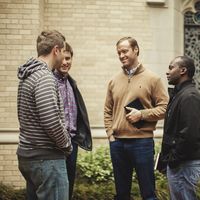
Many of us don’t have to board international flights to reach people from other religions and cultures. We just need to open our eyes, look around, and engage the nations in our own cites and towns….8...
Context Our text for this week is the initial greeting of Paul's letter to the church in Corinth. This is the first of four weeks for which the epistle reading comes from the beginning of 1 Corin...
Context Our text for this week is the initial greeting of Paul's letter to the church in Corinth. This is the first of four weeks for which the epistle reading comes from the beginning of 1 Corin...
In this excerpt, author David Zahl challenges the common belief that religion is “in decline.” He argues that while Westerners, particularly younger generations, may be distancing themselves from the ...
The Church was the one institution whose mission depended on galvanizing attention; and through its daily and weekly offices, as well as its sometimes-central role in education, that is exactly what i...
In Paul’s day the church quarreled over the Jewish law and over genealogies, over meat sacrificed to idols and sabbath practices, and over favoritism shown to the rich patrons and negligence shown to ...
Today, unlike almost any other earlier period, the money and the strong educational institutions of Christianity are in one part of the world, while a majority of the active believers are located else...
Titus 3:4-7, John 3:16, Ephesians 2:8-9, 1 Peter 3:18, Romans 5:8, Colossians 1:19-20, Philippians 2:6-8
To tell someone what you believe may be to answer the wrong question—better to say, instead, what the church believes, better to use the language the church has bequeathed to us to shape our experienc...
We structure our churches and maintain them so as to shield us from God and to protect us from genuine religious experience…The adult members of churches today rarely raise serious religious questions...
James 1:27, Isaiah 1:17, Psalm 68:5, Matthew 25:34-40, 1 Timothy 5:3-4, Zechariah 7:9-10, Matthew 12:48-50, Romans 8:14-17, Luke 4:18, Acts 4:34-35, James 2:15-16
Christianity revitalized life in Greco-Roman cities by providing new norms and new kinds of social relationships able to cope with many urgent urban problems. To cities filled with the homeless and im...
God built into the creation a variety of cultural spheres, such as the family, economics, politics, art, and intellectual inquiry. Each of these spheres has its own proper "business" and nee...
Psalm 2:10-11, John 18:36, Matthew 5:13-16, Jeremiah 29:7, Micah 6:8, 1 Samuel 15:22
We can’t separate what we believe in the political arena from who we are in Christ and what obedience to God demands...That said, not every tenet of Christianity should become the law of the state. We...
Even more germane to the concerns of this book, it is important to remember how the American concern for enumerating Christian work can look to non-Americans. Kanzo Uchimura (1861-1930) was a Japanese...
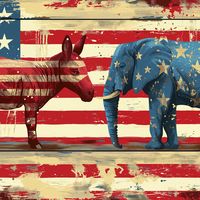
The wall Jefferson referred to is designed to divide church from state, not religion from politics. Church and state are specific things: the former signifies institutions for believers to congregate ...
Revelation 11:15, Matthew 28:19, Galatians 3:28, Matthew 8:10-11, 1 Corinthians 15:25-26
What shall I say of the Romans themselves, who fortify their own empire with garrisons of their own legions, nor can extend the might of their kingdom beyond these nations? But Christ’s name is extend...
In this short (and humorous) excerpt, author David Zahl shares a definition of the secular: Perhaps secular warrants its own explanation, though. My most immediate association comes from the belov...
Esther 4:14, 1 Samuel 15:22-23, Proverbs 24:33-34, Matthew 9:37-38, 2 Corinthians 6:2, Psalm 95:7-8
In 1258, Islam stood on the brink of collapse, with Egypt as its last stronghold. While Islam was struggling, the vast Mongol Empire, under the rule of Kublai Khan, stretched from the Black Sea to the...
John 18:36, Matthew 6:9-10, Matthew 6:33, Luke 17:20-21, Matthew 5:3, 10, Philippians 2:9-11
While I don’t agree with late professor and scholar Marcus Borg on significant theological positions, I appreciate how he described the context surrounding Jesus’ new paradigm of kingdom living: In hi...
One of [Lamin] Sanneh's key arguments is that while the spread of Islam has drawn ever-increasing numbers to the globalizing influence of Arabic, the spread of Christianity binds ever-increasing n...
The Indian is making an amazing discovery, namely that Christianity and Jesus are not the same - that they may have Jesus without the system that has been built up around Him in the West.
Proverbs 28:20, Revelation 2:10, Matthew 5:10-12, Matthew 10:22, 2 Corinthians 4:8-10, 1 Peter 4:12-14, Romans 8:35-37, John 15:18-20, Psalm 31:23, Matthew 25:21, 1 Corinthians 4:2, 1 Timothy 6:12, Matthew 24:45-46
Pliny, a Roman Governor serving around 112 AD, faced a challenging situation regarding Christianity. Many Church historians believe that by his time, it had become illegal to profess the Christian fai...
John 14:6, Matthew 7:13-14, Acts 24:14, Luke 9:23, Psalm 1:1-2, Psalm 25:4-5
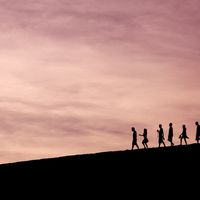
[The] earliest name for Christianity was the Way, suggesting that it was not a set of doctrines to master but a path to travel. Suggesting that each step was a deepening of the familiar and a discover...
In this short excerpt, the abolitionist and former slave Frederick Douglass describes the tension between faith in Christ and faith in a form of Christianity willing to enslave an entire race of peopl...



![[Speaking of the early church] A](https://a-us.storyblok.com/f/1016915/1200x801/ed572a4861/the-early-church.jpg/m/200x200/smart)







![One of [Lamin] Sanneh's key arguments](https://images.unsplash.com/photo-1634128221889-82ed6efebfc3?ixid=M3w1NzU0OTZ8MHwxfHNlYXJjaHwxfHxsYW5ndWFnZXxlbnwwfDB8fHwxNzEzMjc2NzUwfDA&ixlib=rb-4.0.3&q=80&auto=compress&fit=crop&w=200&h=200)

![[The] earliest name for Christianity](https://images.unsplash.com/photo-1535856326707-98d0b5dbe639?ixid=M3w1NzU0OTZ8MHwxfHNlYXJjaHwxfHxKb3VybmV5c3xlbnwxfDJ8fHwxNzEwNTM0MTcxfDA&ixlib=rb-4.0.3&q=80&auto=compress&fit=crop&w=200&h=200)

