A conversation in 1784 between Charles Simeon (a Calvinist and believer in unconditional predestination) and John Wesley (a follower of Arminius, who denied unconditional predestination) can help us u...
2 Corinthians 11:2, Acts 13:50, James 4:13-15, Philippians 2:3-4, Romans 12:17-19, 1 Peter 2:23, 2 Timothy 4:2, 1 Peter 5:2-3, John 21:15-17, 2 Corinthians 4:5, 1 Corinthians 2:1-5
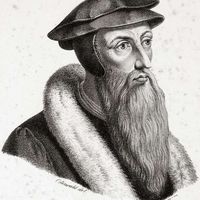
The Protestant Reformer John Calvin (1509-1564) arrived in Geneva to lead the city’s church in 1536, but not, as we might imagine, to universal acceptance. Rather, there was significant resistance and...
Wherever we find the Word of God surely preached and heard, and the sacraments administered according to the institution of Christ, there, it is not to be doubted, is a church of God.
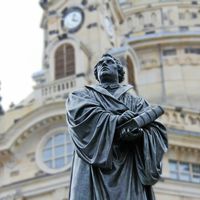
When asked to recant of his writings, Luther replied, “Unless I am convinced by sacred Scripture or by evident reason, I cannot recant. For my conscience is held captive by the word of God and to act ...
Preaching Commentary Paul’s Gospel In 1 Corinthians 1:17-25 we find the gospel that Paul preaches summarized in Christ’s crucifixion. Here in 2 Timothy 2:8, Paul’s gospel is encapsulated in Christ’...
Mark 10:42-45, Matthew 20:25-28, 1 Corinthians 1:12-13, 1 Timothy 4:12, John 7:16, Galatians 1:10, 2 Timothy 4:3-4, 2 Corinthians 4:5, John 3:30, 1 Corinthians 2:1-2
When Martin Luther discovered that some had begun calling the first Protestants “Lutherans,” he strongly objected. It is funny to think that some 500 years later, many are still known by his name: ...
Preaching Commentary Paul’s Gospel In 1 Corinthians 1:17-25 we find the gospel that Paul preaches summarized in Christ’s crucifixion. Here in 2 Timothy 2:8, Paul’s gospel is encapsulated in Christ’...
Preaching Commentary A Christmastide Community A recent podcast reminded me that there is no such thing as a “neutral” marking of our time—our minutes and our hours, our days and our weeks, our mon...
Summary This is one of those texts where it’s pretty easy to laugh at the disciples. This is the second time Jesus told them he was going to die and then rise again after three days. And yet they wer...
Context Reading Someone Else’s Mail Paul first visited the city of Corinth in south-central Greece during his 2 nd missionary journey (Acts 18:1-18). Paul in 1 Corinthians is responding to a letter...
Hilaire Belloc (1870–1953), an author, critic, and devout Roman Catholic, lived in a Britain where strong anti-Catholic sentiment prevailed. Known for his passion and unwavering conviction, Belloc dec...
Context Reading Someone Else’s Mail Paul first visited the city of Corinth in south-central Greece during his 2 nd missionary journey (Acts 18:1-18). Paul in 1 Corinthians is responding to a letter...
Preaching Commentary Parakalō There are a lot of interesting words in this passage, including the second one. In the NIV, it says, “I urge...” In English, “urge” has some range. If I “urge you to r...
Job 1:42, Daniel 3:, Matthew 5:10-12, Romans 8:35-39, Psalm 23:4
John Chrysostom, the eloquent Church Father, had incurred the wrath of the Byzantine (aka Roman) Emperor Arcadius. Enraged, the emperor consulted his counselors on how to punish the powerful preacher....
Ancient Lens What can we learn from the historical context? Corinth: "Young, Scrappy, and Hungry" Corinth was an up-and-coming city with an up-and-coming attitude. The Romans had conque...
Preaching Commentary Background to the Letter and Passage Paul’s letter to the Ephesians was probably intended for wider distribution and use among the various churches around Ephesus. As such, the...
Luke 17:5-10, Luke 17:1-4, 1 Corinthians 6:19-20, John 15:15
Introduction Our lectionary text is inextricably linked with the five verses that precede it. For that reason, I’ll give a summary of verses 1-4. It’s possible the lectionary authors chose to separat...
Introduction Sometimes verses 1-4 are separated from 5-10 in preaching. N. T. Wright points out, however, that in both sections, the need for humility binds the passages together. A teacher must prac...
Ancient Lens What can we learn from the historical context? Corinth: "Young, Scrappy, and Hungry" Corinth was an up-and-coming city with an up-and-coming attitude. The Romans had conque...
The Danish philosopher and contrarian Soren Kierkegaard once compared Christians of his time to a flock of geese in a barnyard. Every week, they listened to an eloquent speaker who recounted the stori...
1 John 2:17, Romans 8:38-39, Philippians 3:20, Colossians 3:1-2, John 15:5, Jeremiah 17:7-8
A Tree in Which to Perch An impressive California Sycamore tree used to grace our village. It rose majestically by the water’s edge, a few yards away from the wooden bridge that spans the lake whi...
Finally, brothers, rejoice! Be perfected. Be comforted. Be of the same mind. Live in peace, and the God of love and peace will be with you. Inclusive Version Finally, brothers and sisters, rejoice...
Revelation 2:10, Psalm 71:20-21, Philippians 3:10-14, Luke 21:16-19, 2 Corinthians 4:17-18, Romans 8:17-18, James 1:12
One of the great leaders of the first generation after the apostles was a man named Polycarp. Polycarp, it is believed, was discipled by the apostle John and carried out a long and fruitful ministry i...
In a November 1882 sermon on 1 John 2, the renowned pastor and preacher C. H. Spurgeon offers a profound insight into the nature of Christian maturity. His remarks come as part of his exposition on th...
While primarily known today as the author of Gulliver’s Travels, Jonathan Swift also served as an Anglican priest in his home country of Ireland. While his writing gained significant traction througho...
Parakalō There are a lot of interesting words in this passage, including the second one. In the NIV, it says, “I urge...” In English, “urge” has some range. If I “urge you to reconsider,” we all kno...
Preaching Commentary An Introduction from Luke Our passage begins with a note from the author (Luke) to his reader (Theophilus), which reminds us that Luke-Acts was initially meant to be two parts ...
Background to the Letter and Passage Paul’s letter to the Ephesians was probably intended for wider distribution and use among the various churches around Ephesus. As such, there is no particular cri...