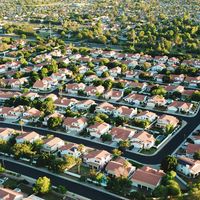
More than 50 percent of Americans live in suburbs, and many of them desire to live a Christian life. Yet often the suburbs are ignored (“Your place doesn’t matter, we’re all going to heaven anyway”), ...
Retail therapy gives us the thrill of the hunt and a hit of dopamine (the love hormone) as we anticipate a purchase, but it cannot feed our hungers. We know this. But we return each time, hoping it wi...
In a knowledge-based economy, the way we make ourselves seen and even validated is through more work. Busyness shows us that we’re valuable, contributing members to society. So whether we can’t stop c...
Perhaps there is no object more desired than a house in America. Meghan Daum writes in her hilarious and poignant book Life Would Be Perfect If I Lived in That House, “There is no object of desire qui...
The advantage that cities and traditional neighborhoods have over sprawling suburbs with respect to interdependence is that they allow people of a greater variety of ages to participate meaningfully i...
More people of color than whites live in the city of Dallas and in the city of Fort Worth. But they are more likely to live in poorer inner-city areas while whites live in the more affluent suburbs. D...
Galatians 5:13-14, Matthew 16:24-25, Romans 12:4-5, Philippians 2:3-4, Ephesians 2:8-10
In her excellent book on following Jesus in the suburbs, Ashley Hales describes one of the ways in which our discipleship has been influenced by modern secular trends such as the desire for self-actua...
The ways that social structures and institutions systematically work against the interest of people of color is called institutional racism. Institutional racism and historic racism are not unrelated ...
The creation of a white standard in the world during the age of exploration, and the white structural privilege prevalent for so long in America, led to what is often called “white privilege”. This is...
Society still has its share of fifth sparrows: indistinct souls who feel dispensable, disposable, worth less than a penny. They drive carpools and work in cubicles. Some sleep beneath cardboard on the...
During a large part of my childhood my father was in school, so we never really went on a traditional “vacation” until late in my elementary school years. I distinctly remember one of our first trips,...
Cars have allowed us to spread out our living patterns significantly. Historically, cities have had a natural limit set by how far people could comfortably walk from place to place. Then, with the dev...
In the fall of 1986, just out of college, I set out to hitchhike across the northwestern part of the United States. I’d hardly ever been west of the Hudson River, and in my mind what waited for me out...
It might be more accurate to say that the fear of cities, or the fear of of one another, or possibly the love of convenience has been the actual basis of much of our current perceptions about the city...
American cities are like badger holes, ringed with trash--all of them--surrounded by piles of wrecked and rusting automobiles, and almost smothered in rubbish. Everything we use comes in boxes, carton...
Matthew 5:25, Matthew 23:7, Mark 5:56, Matthew 25:27, Luke 19:23, Mark 12:1-12, Matthew 8:5, Matthew 9:10, Luke 5:27
One could not live in any village in lower Galilee and escape the effects and ramifications of urbanization.” Life here was urbanized and urbane as anywhere else in the Empire. Did these urban influen...
What will be remembered about the twenty-first century…is the great, and final, shift of human populations out of rural, agricultural life and into cities. We will end this century as a wholly urban s...
There are churches that are merely in the city. Their heartbeat is to get people in the doors to hear the gospel. That's a good goal. But, unfortunately, that's often where it ends. Such churc...
The couple in the garden was to multiply, so providing the citizens of the city. Their cultivation of earth's resources as they extended their control over their territorial environment through th...
We live in an urban world. Half of the world’s population already lives in cities, generating more than 80 percent of global GDP today. But the urban economic story is even more concentrated than this...
In the past three centuries in the West—the period of “modernity”—place has come to be not only neglected but actively suppressed. Owing to the triumph of the natural and social sciences in this same ...
[There] are social idols that capture the life of the city…overarching sinful narratives on which people rely. We have to exegete them. We have to spot them out. We have to capture their core values, ...
In 2017 Rebekah Morris was teaching English and journalism at Cross Keys High School, a public high school in Atlanta. Noticing that her students had really important, insightful things to say about t...
Cities aren’t full of poor people because cities make people poor, but because cities attract poor people with the prospect of improving their lot in life. [Thereofre] we should worry more about place...