The servant role was completed in Jesus. Though there were auspicious sings that preceded and accompanied his birth, preparing the world for the majestic and kingly, the birth of Jesus itself was of t...
Luke 2:6-7, Isaiah 9:6, Philippians 2:6-7, Luke 4:18-19, Mark 4:35-41, Colossians 1:15-17, Hebrews 1:3
‘Gentle Jesus, meek and mild’, Such a dainty, fragile child, But the one we know is bold and strong We can hear that in your dying song, Little boy, little boy. ‘Just a boy of flesh and b...
Matthew 5:20, Romans 14:17, Luke 17:20-21, Matthew 28:18-20, Philippians 2:14-15
T. S. Eliot once described the current human endeavor as that of finding a system of order so perfect that we will not have to be good. The way of Jesus tells us, by contrast, that any number of syste...
John 1:46, 1 Corinthians 1:26-29, Matthew 20:16, Luke 1:51-53, James 2:1-9, Matthew 11:25, Isaiah 52:2-3, Philippians 2:5-8
The world has always despised people from the wrong places and with the wrong credentials. We are always trying to justify ourselves. We need desperately to feel superior to others. And everything abo...
Colossians 1:15, John 1:14, Hebrews 1:3, John 14:9, Philippians 2:6-7
Origen, in the third century, had a great analogy. He told of a village with a huge statue—so immense you couldn’t see exactly what it was supposed to represent. Finally, someone miniaturized the stat...
Luke 2:7, Philippians 2:7, Hebrews 2:9, Genesis 15:
The Child of glory, The Child of Mary, Born in the stable; The King of all, Who came to the wilderness And in our stead suffered; Happy they are counted Who to Him are near. When He Himself sa...
Isaiah 1:1, 10-20, 2 Corinthians 12:9, Matthew 6:10, Matthew 5:3, 10, 1 Corinthians 1:27, 2 Corinthians 12:9, Matthew 26:28, Matthew 19:24, Philippians 3:7, Hebrews 12:2, Matthew 5:6, Matthew 28:19
The context The parables we hear this week are part of a collection of parables of the Kingdom collected by Matthew in chapter 13 of his gospel account. As with the Sermon on the Mount (Matthew 5-7),...
Ancient Lens What can we learn from the historical context? Broader Context of Philippians Paul is concerned that Judaizers (those that require Christians to follow the Torah) are going to corrup...
Preaching Commentary Introduction Believed to be some of Paul’s last words of his long ministry, 2 Tim. 4:6ff are Paul’s closing remarks to his beloved disciple, Timothy. Imprisoned in Rome by this...
Matthew 13:31-33, 2 Corinthians 12:9, Matthew 6:10, Matthew 5:3, 6, 10, 1 Corinthians 1:27, Matthew 26:28, Matthew 19:24, Philippians 3:7, Hebrews 12:2, Matthew 28:19
The context The parables we hear this week are part of a collection of parables of the Kingdom collected by Matthew in chapter 13 of his gospel account. As with the Sermon on the Mount (Matthew 5-7),...
Matthew 13:31-33, 44-52, 2 Corinthians 12:9, Matthew 6:10, Matthew 5:3, 6, 10, 1 Corinthians 1:27, Matthew 26:28, Matthew 19:24, Philippians 3:7, Hebrews 12:2, Matthew 5:6, Matthew 28:19
preaching commentary The context The parables we hear this week are part of a collection of parables of the Kingdom collected by Matthew in chapter 13 of his gospel account. As with the Sermon on t...
Philippians 2:5-8, Matthew 26:36-39, Matthew 4:1-11, Matthew 3:13-17, Luke 4:16-21, John 6:5-14, Matthew 17:1-5
Jesus loved the will of His Father. He embraced the limitations, the necessities, the conditions, the very chains of His humanity as He walked and worked here on earth, fulfilling moment by moment His...
Matthew 25:35-40, James 1:27, Philippians 2:3-4, John 13:3-5, Micah 6:8, Isaiah 58:6-7, 1 John 3:18
An ancient legend tells of a well-respected rabbi who would vanish from his synagogue for a few hours each Sabbath. His mysterious absences sparked curiosity among his students, who wondered if their ...
John 1:14, Philippians 2:6-8, Luke 2:7, Matthew 1:23, 1 Peter 2:24
The Son of God did not want to be seen and found in heaven. Therefore he descended from heaven into this humility and came to us in our flesh, laid himself into the womb of his mother and into the man...
Philippians 2:4-11, Matthew 25:31-46, Mark 9:35, Mark 10:42-45, Ephesians 2:10, John 13:12-17
Our mission is the mission of Jesus Christ. He lived as an ordinary human being. We will care for the common life of humanity. He served men and women. We are committed to working for human wel...
Ancient Lens What can we learn from the historical context? Israel’s State of Mind The Book of Isaiah is a remarkable accounting of the history of the relationship people of Israel with God. By t...
Luke 2:46-47, Psalm 119:105, John 15:10, Matthew 4:1-11, Philippians 2:8, James 1:22
It is easy to observe that Jesus was far from uneducated. He was perfectly at home both in holy scripture and in oral tradition, and he knew how to apply this scholarly heritage.
The Servant Leader The servant leader is the hero of this text. And the example, par excellence, is the Apostle Paul. He has never shied away from holding himself up as a person to be imitated, as...
Philippians 2:5-7, Romans 8:29, Matthew 5:16, Colossians 3:12-14, John 13:15
R.W. DeHann wrote of a missionary who, shortly after arriving on the field, was speaking for the first time to a group of villagers. He was trying to present the gospel to them. He began by describing...
preaching commentary The Servant Leader The servant leader is the hero of this text. And the example, par excellence, is the Apostle Paul. He has never shied away from holding himself up as a pe...
"Maundy" What? Maundy Thursday takes its name from the Latin version of John 13:34: "A new commandment I give to you, that you love one another: just as I have loved you, you also are ...
John 18:36, Matthew 6:9-10, Matthew 6:33, Luke 17:20-21, Matthew 5:3, 10, Philippians 2:9-11
While I don’t agree with late professor and scholar Marcus Borg on significant theological positions, I appreciate how he described the context surrounding Jesus’ new paradigm of kingdom living: In hi...
John 4:7-26, Mark 10:46-52, Matthew 19:13-15, Luke 19:1-10, Mark 5:21-43, Philippians 2:3-4
A striking dimension of Jesus’ capacity to love was his ability to be totally present with people. In all the Bible, Jesus never says to anyone, “Huh? What did you say? I wasn’t paying attention. I wa...
We all live between two worlds. We are planted here on earth while our hope is in heaven. We are given work to do in temporary soil that, we’re told, has the potential to spring up into unending fruit...
Philippians 2:8, Luke 23:34, Matthew 27:46, John 19:17-18, Isaiah 50:6, John 19:1
Jesus learned how to walk, stumbled and fell, cried for his milk, sweated blood in the night, was lashed with a whip and showered with spit, was fixed to a cross, and died whispering forgiveness on us...
Mark 1:4-11, Isaiah 40:3, Mark 2:7, Philippians 2:7, Isaiah 53:null, Hebrews 4:15, 2 Corinthians 8:9, Mark 1:1-3
Enter John the Baptist John the Baptist enters the stage in Mark 1 as the “voice of one crying in the wilderness,” (Isaiah 40:3) whose message and ministry is to “prepare the way of the Lord.” Mark d...
Luke 19:10, Luke 2:7, John 19:18, Philippians 2:8-9, Isaiah 53:5, 2 Corinthians 5:17
In the sixteenth century, Jesuit missionary Matteo Ricci journeyed to China, bringing religious art to share the Christian story with those unfamiliar with it. The Chinese readily embraced images of t...
Context Paul in Ephesus: His Third Missionary Journey This passage describes Paul’s arrival in Ephesus during his third missionary journey. He finds there some disciples who know only of John’s bapt...
John 12:1-8, Mark 14:1-2, Matthew 26:3-13, John 11:45, Luke 7:44-47, Matthew 26:6, Mark 14:3, Luke 7:40, John 11:50-53, Luke 24:41-43, John 21:10-14, Acts 10:40-41, John 12:7, Philippians 2:6-8, Romans 6:1-10
Introduction This narrative is slightly changed from the Synoptic accounts. Matthew and Mark’s Gospels place this narrative two days prior to the Passover (Matt: 26:6-13; Mark 14:1). Three Evangelist...
Philippians 2:6-8, John 1:10-11, Isaiah 53:3-4, Matthew 11:19, Mark 15:34, Isaiah 53:12, Luke 15:20-24, Revelation 7:13-14
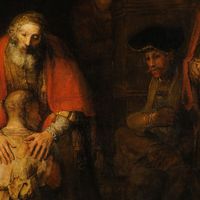
In this excerpt, the French monastic leader Frere Pierre Marie, shares an interpretation of Jesus as the true prodigal son—bringing all of us home with him: He, who is born not from human stock, or ...