For years, Bible scholars have danced around the matter by saying slavery in Rome was far different from slavery in the first few centuries of American history. No doubt their observations carry a mea...
Genesis 12:2-3, Psalm 1:1-3, Matthew 5:3-12, Galatians 3:8-9, Genesis 12:2-3
Blessing in the ancient world was the highest form of well-being possible for human beings. The Greeks referred to the blissful existence of the gods as “blessed.” For Israel, blessing included not ju...
The resurrection affirms that sin and death do not have the last word. At the cross the finest religion of the ancient world (Judaism) and the finest system of justice of the ancient world (Rome), joi...
Ancient lens What's the historical context? Ancient Boundaries The world of Jesus and of the early church saw a Jewish people that had well-established boundary practices. These were behavior...
Lent 2024: Do This in Remembrance Remembrance and Gratitude AIM commentary Ancient lens What's the historical context? Ancient Boundaries The world of Jesus and of the early church sa...
Psalm 19:null, Psalm 1:null, Psalm 119:null, Exodus 20:2-3, Galatians 3:24-26, John 14:6, Matthew 22:37-40
Ancient Lens What can we learn from the historical context? The Books of the Psalms and David The Book of Psalms is divided into five books, like the five books of the Torah. While it is not obvi...
Psalm 19:, Psalm 1:null, Psalm 119:null, Exodus 20:2-3, Galatians 3:24-26, John 14:6, Matthew 22:37-40
Lent 2021: A 40-day Heart Restoration Nature, Law, & Holiness Bonus Content: Video prep session with Austin Hill on Psalm 19 . Password: %h+CNTJ7 AIM Commentary Ancient Lens What can we ...
Jeremiah 31:31-34, John 12:16, John 12:23-26, John 12:31-32, Romans 11:26-27, Hebrews 10:5-12, Galatians 6:2
Lent 2021: A 40-day Heart Restoration Heart Renewal Bonus Content: Video prep session with Jonathan Cornell on Jeremiah 31:31-34 . AIM Commentary Ancient Lens What can we learn from the his...
Jeremiah 31:31-34, John 12:16, John 12:23-26, John 12:31-32, Romans 11:26-27, Hebrews 10:5-12, Galatians 6:2
Bonus Content: Video prep session with Jonathan Cornell on Jeremiah 31:31-34 . Ancient Lens What can we learn from the historical context? Covenants and Kings God’s people Israel lived in rela...
Romans 8:15, Galatians 4:6, Hebrews 10:24-25, John 14:27, James 1:5
Loving God: Abba—our Father; Jesus—our Savior; Spirit—our Comforter. As Advent begins ... we take a deep breath, we grit our teeth and steel our nerves anticipating the fast pace of the next few week...
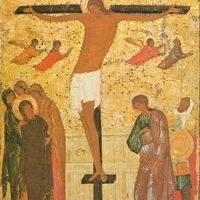
God could have chosen any method to save us, but he used the cross. The cross is our spiritual centerpiece, the sign of our soul’s emancipation. However, the pre-Christian cross might offer a sliver ...
Romans 12:2, Galatians 6:1, Proverbs 9:10, James 1:4, Isaiah 61:3
Think of an ancient icon of Christ. Imagine that a thousand-year-old Christ Pantocrator painted on a wooden panel is discovered in some forgotten monastery. The image of Christ is there, but it’s cove...
Matthew 22:37-39, Matthew 25:35-40, Luke 3:11, Ephesians 5:2, Acts 2:42-47, James 2:14-17, Galatians 2:10, Psalm 72:12-14
A passage often referred to in order to describe the sacrificial, countercultural quality of the early church comes to us interestingly enough, from one of its strongest critics, known later to histor...
I grew up as a Christmas and Easter Methodist. Our family called ourselves Christians, but it was not an important part of our lives. I found church boring. When I turned eighteen, something happened ...
James 1:27, Hebrews 13:2-3, 1 Peter 2:12, Galatians 6:10, Romans 12:13, Acts 2:44-45
The fourth-century emperor Julian (AD 331-336) feared [Christians] might take over the empire. Referring to Christians as “Galileans” and Christianity as “atheism” (because of their denial of the exis...
Matthew 28:18-20, Acts 1:8, Acts 10:34-35, Galatians 3:28, Romans 1:16, John 4:21-24, Psalm 22:27-28
[Speaking of the early church] A cosmopolitan spirit grew, particularly in the cities, that transcended national barriers. Old tribal distinctions and identities were breaking down, leaving people rip...
Former Archbishop of Canterbury William Temple describing original sin I am the centre of the world I see; where the horizon is depends on where I stand…Education may make my self-centeredness less ...
Matthew 22:39, Philippians 2:3-4, 1 Corinthians 10:24, Romans 15:1-2, Galatians 6:10, Romans 12:10, Acts 20:35, Matthew 25:35-40, Isaiah 58:6-7, Proverbs 19:17, Luke 10:30-37, James 2:15-16, 1 John 3:17, Proverbs 31:8-9, Matthew 25:40, Acts 11:29-30, 2 Corinthians 8:13-15, Acts 2:44-45, Acts 4:32-35, 1 Corinthians 12:25-26
Pursuing the common good has been a strong marker of the Christian church from the very beginning. The early church had many habits that they became known for, of course—including meeting frequently, ...
John 4:7-26, John 6:1-15, Galatians 4:21-31, Psalm 42:7, Psalm 121:null
New Testament Mountains Like the Old Testament, the New Testament has plenty of references to mountains. There’s the Sermon on the Mount, obviously. Jesus often went onto hills or mountains to pray...
John 4:7-26, 1 Corinthians 2:12, 1 Peter 12:12-23, John 6:1-15, Galatians 4:21-31, Psalm 42:7, Psalm 121:null
New Testament Mountains Like the Old Testament, the New Testament has plenty of references to mountains. There’s the Sermon on the Mount, obviously. Jesus often went onto hills or mountains to pray...
Revelation 11:15, Matthew 28:19, Galatians 3:28, Matthew 8:10-11, 1 Corinthians 15:25-26
What shall I say of the Romans themselves, who fortify their own empire with garrisons of their own legions, nor can extend the might of their kingdom beyond these nations? But Christ’s name is extend...
Matthew 5:48, 1 John 3:2-3, Galatians 5:16-17, Philippians 3:13-14, Colossians 3:1-2, Ephesians 4:22-24
The scholastics used to say: Homo non proprie humanus sed superhumanus est —which means that to be properly human, you must go beyond the merely human.
So if we want to get the church right, we have to learn to see it as a salad in a bowl, made the Right Way of course. For a good salad is a fellowship of different tastes, all mixed together with the ...
Matthew 14:13-21, Matthew 13:55, Matthew 14:2, Matthew 16:16, Matthew 17:1-13, Isaiah 55:1, John 6:1-15, Matthew 13:31, 2 Kings 4:42-44, Matthew 26:26, Matthew 8:null, Galatians 6:2
Preaching Commentary Context The feeding of the 5,000 in Matthew occurs within a section where questions of Jesus’ identity are heightened. Two incorrect answers of who Jesus truly is are given in...
Matthew 22:1-14, Matthew 21:28-32, 33-44, Matthew 20:1-16, Matthew 24:null, Galatians 3:8
Kingdom Reversals This parable of Jesus is like the other two before it (cf., Matt. 21:28–32, 33–44) in that its focus is on kingdom reversals. Continuing the theme begun in Matt. 20:1–16 where the l...
Leviticus 19:18, Isaiah 58:6-7, Galatians 3:28, James 2:1-9, Psalm 82:3
There is a story, which is fairly well known, about when the missionaries came to Africa. They had the Bible and we, the natives, had the land. They said “Let us pray,” and we dutifully shut our eyes....
Galatians 6:10, Hebrews 11:13-16, 2 Corinthians 6:9-10, Matthew 5:44, 1 Peter 2:11-12, John 17:15-16
In an early Christian document known as the Epistle to Diognetus (c. A.D. 120-200), the author wrote a response to some propaganda circulating in the Roman Empire. People had spread false rumors about...
Matthew 14:13-21, Matthew 13:55, Matthew 14:2, Matthew 16:16, Matthew 17:1-13, Isaiah 55:1, John 6:1-15, Matthew 13:31, 2 Kings 4:42-44, Matthew 26:26, Matthew 8:null, Galatians 6:2
Context The feeding of the 5,000 in Matthew occurs within a section where questions of Jesus’ identity are heightened. Two incorrect answers of who Jesus truly is are given in 13:55 (“isn’t this the...
Hebrews 13:20, Genesis 1:26-28, Genesis 1:26, Genesis 3:14-19, Genesis 3:14, Genesis 8:20-9, Genesis 9:5-6, Genesis 12:1-3, Galatians 3:16, John 8:56-58, 2 Corinthians 3:7-9, Deuteronomy 30:1-10, Deuteronomy 30:1, 2 Samuel 7:4-17, Luke 1:31-33, Acts 1:6, Revelation 19:16, Matthew 26:28, Mark 14:24, Luke 22:20, Hebrews 8:8-12, Galatians 3:13-20
Eternal covenant, Heb 13:20—The redemptive covenant before time began, between the Father and the Son. By this covenant we have eternal redemption, an eternal peace from the ‘God of peace’, through th...








![[Speaking of the early church] A](https://a-us.storyblok.com/f/1016915/1200x801/ed572a4861/the-early-church.jpg/m/200x200/smart)