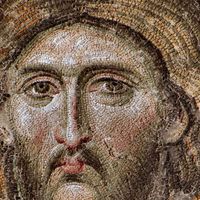
1 Corinthians 12:8-12, John 1:, John 17:18, Philippians 2:6-11, 1 John 1:7, Romans 8:1, Colossians 1:13-14
The Cave One of the most famous passages in Plato's Republic is his "Allegory of the Cave," which is found at the beginning of book seven . Socrates imagines the human condition al...
John 1:1-14, Isaiah 61:10, Isaiah 62:1, Psalm 147:1, Proverbs 8:22-31
Introduction John 1 contains some of the richest Christological passages in all of Scripture. It rewards deep meditation on its meaning. Its use as the Christmas gospel text is an opportunity to infu...
John 1:1-14, Proverbs 8:22-23, 30-31, John 20:28-29
Preaching Commentary Introduction John 1 contains some of the richest Christological passages in all of Scripture. It rewards deep meditation on its meaning. Its use as the Christmas gospel text is...
Ancient Lens What can we learn from the historical context? Paul’s Relationship to Philippi There is practically no debate that Philippians was written by Paul. This letter is an intimate portray...
Ancient Lens What can we learn from the historical context? A letter of friendship Paul’s letter to the Philippians is from Paul and his companions to the saints in Philippi. It is a letter fro...
Ancient Lens What's the historical context? A Hard Saying The difficulty of this saying was used by opponents of the early Christians to justify persecution, yet the early church still rallie...
Ancient Lens What's the historical context? A Hard Saying The difficulty of this saying was used by opponents of the early Christians to justify persecution, yet the early church still rallie...
If the phrase “theology of the body” seems odd, perhaps it’s because we haven’t taken the reality of the incarnation as seriously as Scripture does. There’s nothing surprising about looking to the hum...
Check out our video discussion of the text with Austin D. Hill & Stu Strachan. Click here to view! The small size of Bethlehem reminds one of a common biblical theme: When God is about to do ...
John 1:1-14, John 1:1, Genesis 1:null, Colossians 1:null
God expressed Himself J.B. Phillips paraphrases the first line of John 1:1, “At the beginning God expressed himself ”. God’s word is more than mere speech. His word is action. When God speaks in Gen...
C.S. Lewis on the Incarnation: We catch sight of a new key principle—the power of the Higher, just in so far as it is truly Higher, to come down, the power of the greater to include the less. . . . ...
Christianity is almost the only one of the great religions which thoroughly approves of the body—which believes that matter is good, that God Himself once took on a human body, that some kind of body ...
Colossians 1:15-17, Hebrews 1:3, 2 Corinthians 4:4, John 1:18, John 10:30, John 14:9
Christmas in May I’m pretty sure it was Stephen Covey, back in the day ( The Seven Habits of Highly Effective People ) who originally said, “The main thing is to let the main thing be the main thing...
I take literally the statement in the Gospel of John that God loves the world. I believe that the world was created and approved by love, that it subsists, coheres, and endures by love, and that, inso...
Jesus, though you were in very nature God, you did not consider equality with God as something to be used to your own advantage. Rather, you humbled yourself, you made yourself nothing. Lord, you are ...
Preaching Commentary A Christmastide Community A recent podcast reminded me that there is no such thing as a “neutral” marking of our time—our minutes and our hours, our days and our weeks, our mon...
Leader: Let the same mind be in you that was in Christ Jesus, who though He was in the form of God did not regard equality with God as something to be exploited, People: But emptied Himself, taking ...
Pastor: "Have this mind among yourselves, which is yours in Christ Jesus, who, though he was in the form of God, did not count equality with God a thing to be grasped, but emptied himself, by tak...
Luke 1:26-38, Luke 1:46, Isaiah 7:14, Matthew 1:19, Revelation 11:15, Luke 1:46-48, John 8:41, 1 Corinthians 1:23, 1 Corinthians 1:27-29
Ancient lens What's the historical context? Couldn’t See That Coming Powerful parents with a family pedigree derived from Judah and the Davidic line was the common narrative for how most peop...
Beloved, Let us love one another; for love is of God And everyone who loves has been born of God, and knows God. The one who does not love does not know God, for God is love. By this God’s lov...
John's Imprisonment, Jesus' Debut John the Baptist is as good as dead when we hear of Jesus’ splash onto the Galilean landscape in Mark 1:14. Mark tells us that Jesus arrives in Galilee preac...
Isaiah 9:6-7, Hebrews 1:1-3, Colossians 1:15-17, Philippians 2:6-8, John 3:16-17, John 1:1-4, Luke 1:30-35
In the ancient world, a place where the veil between the earthly and spiritual was easily pierced, rumors and gossip about great leaders being born of the gods, especially amongst royals, was somewhat...
Will the Real Jesus, Please Stand Up? Quite a few years have passed since I sat through a systematic theology class and had the professor pitch a variety of difficult to hit balls at us regarding the...
Ancient lens What's the historical context? Living as Captives Our text today matches, at least in part, last week’s lectionary passage (Isaiah 40). Just as in Isaiah 40, a message of comfort...
Luke 24:30-31, John 6:51, Matthew 25:35, Hebrews 13:2, Philippians 2:5-8, John 13:14-15, Matthew 26:26-28
All true friendliness begins with fire and food and drink and the recognition of rain or frost. ...Each human soul has in a sense to enact for itself the gigantic humility of the Incarnation. Every ma...
Philippians 2:4-11, Matthew 25:31-46, Mark 9:35, Mark 10:42-45, Ephesians 2:10, John 13:12-17
Our mission is the mission of Jesus Christ. He lived as an ordinary human being. We will care for the common life of humanity. He served men and women. We are committed to working for human wel...
John 1:14, Matthew 9:36, Luke 19:10, John 15:15, Mark 10:45, Philippians 2:5-7, 1 John 4:9-10
The ways Jesus goes about loving and saving the world are personal: nothing disembodied, nothing abstract, nothing impersonal. Incarnate, flesh and blood, relational, particular and local. The ways em...
Ancient Lens What can we learn from the historical context? Israel’s State of Mind The Book of Isaiah is a remarkable accounting of the history of the relationship people of Israel with God. By t...
Ancient Lens What can we learn from the historical context? Back to Bethany The trans-Jordan village of Bethany was the place in which Jesus’ ministry began. It is now the place in which our text...