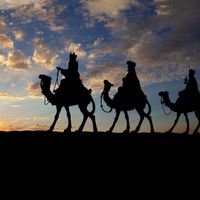
Matthew 2:13–23 sits within Matthew’s infancy narrative (chapters 1–2), which serves as a theological introduction to Jesus’ identity and mission. Unlike Luke’s account, which emphasizes the humble bi...
Matthew 2:13–23 sits within Matthew’s infancy narrative (chapters 1–2), which serves as a theological introduction to Jesus’ identity and mission. Unlike Luke’s account, which emphasizes the humble bi...
Hear the good news – God is not silent, nor is God deaf. The one who watches over you does not sleep or slumber. God hears your prayers, even in those moments when you don’t know what to pray. And God...
For purposes of practicality and relatability, this series considers the Mediterranean Sea and the Red Sea “oceans.” The point is to relate our present-day affinity for the ocean, seashore, and beach...
Commenting on Ephesians 1:3-6, M. Robert Mulholland describes just how powerful it can be personally, when we recognize that we were chosen by God, especially for children who are the result of an unp...
Context A Dire Warning All the way back in the Pentateuch God warned the people of Israel that their residency in the promised land was predicated upon their obedience to the Torah . This can be ...
Preaching Commentary Preaching Angle: The God Who Transforms As the Lectionary readings traverse from last week’s readings in Acts 7 (Stephen’s sermon and martyrdom) into this week’s reading of Pau...
Preaching Commentary Context A Dire Warning All the way back in the Pentateuch God warned the people of Israel that their residency in the promised land was predicated upon their obedience to the ...
Preaching Commentary Context Chapter two of Acts follows the ascension of Jesus and begins with his disciples gathered up all into one place. Before these followers are scattered out into the world...
Preaching Angle: The God Who Transforms As the Lectionary readings traverse from last week’s readings in Acts 7 (Stephen’s sermon and martyrdom) into this week’s reading of Paul’s sermon at the Areop...
AIM Commentary Ancient Lens What can we learn from the historical context? Which Interpretative Lens Should You Use? I have a general rule of thumb when studying a text. If I can read the early...
Preaching Commentary “Historical insecurity” and “cosmic instability” are the ingredients of existential fear that inspire this Psalm of Trust, according to James Mays in his Interpretation Comment...
Ancient Lens What’s the historical context? Background Structure This Psalm of David is unique. “It is the only hymn in the Old Testament composed completely as a direct address to God.” [1] It e...
For purposes of practicality and relatability, this series considers the Mediterranean Sea and the Red Sea “oceans.” The point is to relate our present-day affinity for the ocean, seashore, and beach...
Preaching Commentary God's Sovereignty The sovereignty of God is a pervasive theme in the Bible, expressed in a variety of ways. Daniel’s vision is one of those expressions and a bit more chall...
Leader: The mighty one, God the Lord, speaks and summons the earth from the rising of the sun to its setting. People: Out of Zion, the perfection of beauty, God shines forth. Leader: Our God comes...
Preaching Commentary Plenipotentiary Anyone know what a “plenipotentiary” is? Try that compound Latin word on for size! It is derived from the Latin words plenus “full” and potens “power.” It r...
Context Chapter two of Acts follows the ascension of Jesus and begins with his disciples gathered up all into one place. Before these followers are scattered out into the world, the world has come to...
This scripture guide is adapted from the Summer Settings sermon guide Mountains I . Why Start with Mountains? We start with mountains because there are an abundance of Bible passages related ...
Leader: O Lord, how manifold are your works! In wisdom you have made them all; the earth is full of your creatures. Here is the sea, great and wide, which teems with creatures innumerable, living thin...
“Historical insecurity” and “cosmic instability” are the ingredients of existential fear that inspire this Psalm of Trust, according to James Mays in his Interpretation Commentary series on the Psal...
The Hallelujah Psalter The majestic conclusion to the Psalter is composed of five psalms (sometimes called the “Hallelujah Psalter”) that all begin and end with the exclamatory word of praise, “Halle...
God of grace, power and glory, and our Heavenly Father: You raise up nations in your grace and holiness; and You bring down nations who go after and serve other gods of their own making. You are good–...
Pastor: “'You are my witnesses,' declares the LORD, 'and my servant whom I have chosen, that you may know and believe me and understand that I am he. Before me no god was formed, nor shall...
Heavenly Father, it is astounding how many ways we find to doubt You. At times we doubt Your power and Your ability to do actual miracles in our lives. In other situations, we doubt that Your methods ...
You who fear the Lord, praise him! All you descendants of Jacob, honor him! Revere him, all you descendants of Israel! For he has not despised or scorned the suffering of the afflicted one; h...
Ancient Lens What can we learn from the historical context? Which Interpretative Lens Should You Use? I have a general rule of thumb when studying a text. If I can read the early Christian commen...
The Hallelujah Psalter The majestic conclusion to the Psalter is composed of five psalms (sometimes called the “Hallelujah Psalter”) that all begin and end with the exclamatory word of praise, “Halle...
1 Timothy 3:16, John 1:14, 1 Timothy 1:15, 1 Peter 1:23, James 4:10, 1 John 1:9
Prayer of Adoration Lord—you’re sufficient in everything. You can create without us; save without our assistance; bring good out of evil, hope from despair and restore what we mess up. You’re soverei...