Matthew 5:null, 1 Peter 2:9, Galatians 5:22-23, James 2:17, Romans 12:1, Mark 4:21, Philippians 2:15
Jesus describes his followers as being “salt” and “light” in the world in Matthew 5. When you think about salt, it doesn’t really have a whole lot of value when it’s just sitting in a salt shaker. Si...
Brock Schroeder used to teach astronomy at Olivet Nazarene University in Illinois, and he prided himself on being open to exploring a wide range of perspectives in his life and work. In the natural sc...
2 Corinthians 9:6-8, 1 Peter 4:10, Philippians 2:12-13, 1 Timothy 4:8, Galatians 5:6, Matthew 5:16, James 2:17
Just as our bodies need exercise to be strong physically, our faith needs exercise if we are to be strong spiritually. It has often been noted that several rivers flow into the Dead Sea, but no river ...
Genesis 29:20, Ruth 1:16-17, 1 Samuel 1:9-18, Luke 10:38-42 , Philippians 2:3-4, Psalm 133:1
Emma Darwin, a devoted wife to Charles, did not share his passion for science, nor did she pretend to be captivated by the many lectures and events she attended by his side. On one occasion, as they s...
A new study shows that American students are becoming less proficient in science, and if the trend continues, we will become a nation that's science and chemistry illiterate. And you thought a lot...
A businessman well known for his ruthlessness once announced to writer Mark Twain, “Before I die I mean to make a pilgrimage to the Holy Land. I will climb Mount Sinai and read the 10 Commandments alo...
On December 2, 1943, a German air raid in Italy sank over a dozen ships docked in port. Among them was an American vessel carrying over two thousand mustard gas bombs intended for the war. Soon, toxic...
Augustine said that we were all born into the world of “common grace” [i.e., available to all]. Before one is baptized, or even if one never is, such grace meets one in God’s creation. There is grace ...
We all know that there are regions of the human spirit untrammeled by the world of physics. In the mystic sense of the creation around us, in the expression of art, in a yearning towards God, the soul...
Charles Darwin, known for his theory of natural selection, noticed that his later life included a “loss of happiness.” While he never acknowledged that it might have been related to his changing world...
This paragraph from the scientist and atheist David Friend provides a stark contrast to a Christian conception of life, humanity, and the world we inhabit: We are here because one odd group of fishe...
Right after the turn of the 20th century, a scientist named Duncan McDougall believed he had discovered the weight of a soul. He did this by weighing six patients right before they died and right afte...
1 Corinthians 2:16, Matthew 22:37, Proverbs 4:23, James 1:5, Colossians 3:2, Philippians 4:7, Romans 12:2
According to the ancient Greek philosopher Aristotle, the function of the brain was to keep the body from overheating. In The Parts of Animals, he noted that that the brain was a “compound of earth an...
When I observe the luminous progress and expansion of natural science in modern times, I seem to myself like a traveller going eastwards at dawn, and gazing at the growing light with joy, but also wit...
The accumulated body of scientific knowledge can tell us all about the canvas, oils, and minerals that combine to make a work of art, but they cannot tell us why it takes our breath away.
In this short excerpt, pastor and author Austin Fischer summarizes the late 19th century book Flatland as an analogy for the often-one-dimensional faith that exists our time: tIn 1884, an English sc...
Have you ever heard of the forensic science theory known as Locard’s Exchange Principle? Named after the "Sherlock Holmes of France," the French criminologist Emile Locard, this theory sugge...
The finest emotion of which we are capable is the mystic emotion. Herein lies the germ of all art and all true science. Anyone to whom this feeling is alien, who is no longer capable of wonderment and...
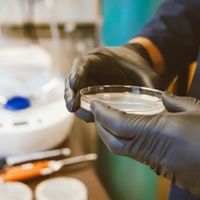
Sir Alexander Fleming (1881–1955), the British microbiologist and co-recipient of the 1945 Nobel Prize for Medicine for the discovery of penicillin, often credited his breakthrough to a fortunate acci...
1 Peter 1:8-9, Philippians 3:20, 1 Corinthians 2:9, John 20:29, 2 Corinthians 5:7
Faith is not something that goes against the evidence, it goes beyond it. The evidence is saying to us, 'There is another country. There is something beyond mere reason'.