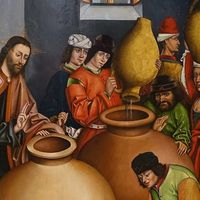
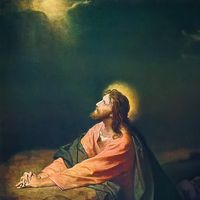
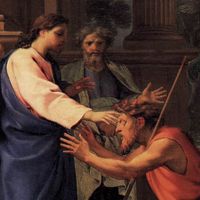
Matthew 14:19-20, John 9:6-7, Mark 2:3-4, John 13:4-5, Mark 1:40-42, Luke 2:7, John 1:14
The gospels are earthy. People are close to the earth. They travel here and there by foot. They eat the live heads of grain growing from the soil as they walk through the fields. They get grubby and h...
John 1:46, 1 Corinthians 1:26-29, Matthew 20:16, Luke 1:51-53, James 2:1-9, Matthew 11:25, Isaiah 52:2-3, Philippians 2:5-8
The world has always despised people from the wrong places and with the wrong credentials. We are always trying to justify ourselves. We need desperately to feel superior to others. And everything abo...
The witness of the New Testament is, therefore, twofold: it transcends the land, Jerusalem, the Temple. Yes: but its History and Theology demand a concern with these realities also. Is there a reconci...
John 1:43-51, John 20:29, 1 Corinthians 13:12, John 4:29, John 4:42
Context Jesus' Ministry Begins This passage is from the first chapter of John’s gospel and describes the beginning of Jesus’ ministry—fitting for the beginning of a new year. A congregation foll...
John 14:6, Isaiah 55:8-9, Matthew 9:10-13, John 18:36, Luke 19:1-10
With a certain oversimplification we can trace easily enough the three options open to Jews in Jesus’ day. … First, the quietist and ultimately dualist option, taken by the writers of the Dead Sea Scr...
Leviticus 13:45-46, Isaiah 53:3-5, 2 Samuel 9:3, 6-7, Mark 1:40-42, Luke 7:37-38, John 20:27
Sociologist Erving Goffman wrote in his classic study Stigma: Notes on the Management of Spoiled Identity that the term stigma originated with the ancient Greeks, roughly during Jesus’ tim...
It is as strange a scene as there is in the Gospels. Even without the voice from the cloud to explain it, they had no doubt what they were witnessing. It was Jesus of Nazareth all right, the man they&...
Context Paul in Ephesus: His Third Missionary Journey This passage describes Paul’s arrival in Ephesus during his third missionary journey. He finds there some disciples who know only of John’s bapt...
Genesis 12:1–3, Exodus 3:1–12, Isaiah 53:, Matthew 22:15–22 , John 4:1–42 , Acts 17:16–34
The world of Jesus was not the Old Testament Hebrew world. Like the United States now, Israel was multicultural, including a combination of Aramaic, Greek, and Roman influences. The people looked Jewi...
Thus, from the standpoint of the gospels, the mighty deeds of Jesus, healings and exorcisms alike, were the product of the power which flowed through him as a holy man. His powers were charismatic, th...
A Tough Way to Start Ministry You don’t have to spend much time on Twitter or Facebook to be reminded that schadenfreude (taking joy from another's misfortune) is alive and well. Depending on w...
Genesis 22:1-18, Isaiah 50:4-7 , 1 Samuel 3:1-10, Matthew 3:16-17 , John 5:19-20 , Psalm 40:6-8
In stark contrast to ourselves, when Jesus needed to know who he was, he listened to his Father’s voice, trusted that voice and claimed its truth for his own life.
John 1:43-51, John 20:29, 1 Corinthians 13:12, John 4:29, John 4:42
Preaching Commentary Context Jesus' Ministry Begins This passage is from the first chapter of John’s gospel and describes the beginning of Jesus’ ministry—fitting for the beginning of a new ye...
Christ became our Brother in the flesh in order that we might believe in him. In him the love of God came to the sinner. Through him men could be sinners and only so could they be helped. All sham was...
Introduction Jesus is the deliverer of Israel (1:54–55, 69–75, 77–79) Jesus states his mission in Luke 4:16-19: to proclaim good news to the poor, liberty to captives and the oppressed. The word ...
Introduction Jesus is the deliverer of Israel (1:54–55, 69–75, 77–79) Jesus states his mission in Luke 4:16-19: to proclaim good news to the poor, liberty to captives and the oppressed. The word J...
2 Corinthians 12:9, John 4:1-26, Jonah 1:4, Luke 19:1-10, Hosea 1:3, Acts 9:1-19
I have come to know a God who has a soft spot for rebels, who recruits people like the adulterer David, the whiner Jeremiah, the traitor Peter, and the human-rights abuser Saul of Tarsus. I have come ...
Colossians 1:15, John 1:14, Hebrews 1:3, John 14:9, Philippians 2:6-7
Origen, in the third century, had a great analogy. He told of a village with a huge statue—so immense you couldn’t see exactly what it was supposed to represent. Finally, someone miniaturized the stat...
Matthew 25:35-40, John 8:1-11, Luke 19:1-10, John 4:1-26, John 8:10-11, Luke 19:10
In these acts of love Jesus created a scandal for devout, religious Palestinian Jews. The absolutely unpardonable thing was not his concern for the sick, the cripples, the lepers, the possessed . . . ...
Intertwined Narratives Jesus’ encounters with Jairus’ daughter and the bleeding woman are sandwiched together with the intention that the two narratives would unlock and help to interpret the other....
Intertwined Narratives Jesus’ encounters with Jairus’ daughter and the bleeding woman are sandwiched together with the intention that the two narratives would unlock and help to interpret the other....
Ancient Lens What can we learn from the historical context? A Letter to Real People In the understanding of, and preaching on, any section of the Revelation of John , it is critical to know that t...
Micah 6:8, Colossians 3:2, Isaiah 58:10, John 6:27, James 2:15-17, Matthew 6:33
In his excellent little book, A Testament of Devotion , written almost a hundred years ago, Thomas Kelly describes the tension that all ministries must live in; the focus on this world or the wor...
Luke 13:31-35, Luke 11:51, Jeremiah 23:6, Deuteronomy 32:11, Ruth 2:12, Psalm 17:8, Isaiah 31:5
Ancient Lens What can we learn from the historical context? On the Road to Jerusalem Luke 13 begins with Jesus teaching on the nature of the kingdom of God and it concludes with our passage, in w...
Exodus 3:11-12 , 1 Kings 19:9-13, Isaiah 42:1 , Matthew 3:16-17 , Luke 9:28-36, Psalm 22:1
Jesus needed, not once, but again and again at each stage of his mission and each crisis in his living and dying, a freshly confirmed knowledge of his own identity.
Mark 13:1-8, Mark 11:, Mark 12:, Ezekiel 10:18-19, Ezekiel 11:22-23
Context In the Book of Mark Mark 13 contains the “Olivet Discourse,” also called “the Little Apocalypse.” At the beginning of this chapter (and our reading), the disciples marvel at Herod’s spectacu...