Philippians 2:null, John 13:14-15, Galatians 6:2, 1 Peter 5:6, James 4:10, Matthew 23:12
Do nothing out of selfish ambition or vain conceit. Rather, in humility, value others above yourselves, not looking to your own interests but each of you to the interests of others. In your ...
Colossians 3:12-13, Ephesians 4:2, Luke 22:26-27, 1 Peter 5:5, Mark 10:43-45
O Lord Jesus Christ, enthroned in the majesty of heaven, who, when you came forth from God, did make yourself one that serves: We adore you because you did lay aside the garment of your glory, and clo...
Ancient Lens What can we learn from the historical context? A letter of friendship Paul’s letter to the Philippians is from Paul and his companions to the saints in Philippi. It is a letter fro...
"Maundy" What? Maundy Thursday takes its name from the Latin version of John 13:34: "A new commandment I give to you, that you love one another: just as I have loved you, you also are ...
Jesus, though you were in very nature God, you did not consider equality with God as something to be used to your own advantage. Rather, you humbled yourself, you made yourself nothing. Lord, you are ...
For reading in unison: Have this mind among yourselves, which is yours in Christ Jesus, who, though he was in the form of God, did not count equality with God a thing to be grasped, but emptied him...
Leader: Let the same mind be in you that was in Christ Jesus, who though He was in the form of God did not regard equality with God as something to be exploited, People: But emptied Himself, taking ...
Philippians 2:6-7, Galatians 2:20, John 10:30, Ephesians 5:21, Colossians 1:19-20, John 15:13, Matthew 20:28
There are two wonderful Greek words that the early church theologians used to describe the Trinity: kenōsis and perichōrēsis. Kenosis is the act of self-giving for the good of another. It is found in ...
2 Corinthians 8:9, Romans 6:4, John 12:24, Galatians 2:20, John 15:13
This total self-giving, to which the Son and the Spirit respond by an equal self-giving, is a kind of “death,” a first, radical “kenosis,” as one might say. It is a kind of “super-death” that is a com...
Philippians 2:null, 1 Corinthians 15:22, Romans 6:4, John 12:24, Luke 24:5-6, Matthew 20:28
In the Christian story God descends to reascend. He comes down; down from the heights of absolute being into time and space, down into humanity; down further still, if embryologists are right, to reca...
Lord, you came among us, not in a way we expected, but as a baby. We had great difficulty seeing you in so small a form, so vulnerable an incarnation. Lord, you came to us where we least expected. Yo...
The kingdom is present not in grandiose accomplishments, but in showing practical love in humble ways, day after day, and in refusing to allow our failures and disappointments to hide God’s love from ...
Lord God, you have given yourself fully and completely To make us your people, a gift of grace to the world We confess that too often we have kept this grace for ourselves For the times when we’ve ...
Pastor: "Have this mind among yourselves, which is yours in Christ Jesus, who, though he was in the form of God, did not count equality with God a thing to be grasped, but emptied himself, by tak...
Romans 12:1-2, Luke 18:13-14, 2 Chronicles 7:14, Psalm 32:5, Isaiah 57:15, James 4:10
Almighty God, you are king of everything. You are Lord of our lives. You control the stars in heavens. And you humbled yourself to be a servant to us. In response to this, we continue to reign as king...
Romans 8:17, Ephesians 2:6, John 10:28-29, 2 Corinthians 5:21, 1 Peter 2:24, Philippians 2:6-8, 2 Corinthians 8:9
Pious souls can derive great confidence and delight from this sacrament, as being a testimony that they form one body with Christ, so that everything which is his they may call their own. Hence it fol...
Isaiah 7:14, Matthew 1:18-25, John 1:1-14, Isaiah 9:6-7
O Come, O Come Emmanuel You who are flesh Vulnerable and Lowly and Small Come, O Come Emmanuel You who are Great Holy and Powerful and Forever Come, O Come Emmanuel The Fullness of God with us Make ...
Galatians 4:4-5, Titus 3:4-7, Philippians 2:8, Hebrews 2:14-15, 17-18, Hebrews 4:15, 1 Peter 4:8, Matthew 5:9
[I] try to get into their world a little bit [by listening to hip-hop], because if they’re only adapting to you and you’re not adapting to them in some way, I don’t think you’ve developed a relationsh...
Philippians 2:6-8, John 1:10-11, Isaiah 53:3-4, Matthew 11:19, Mark 15:34, Isaiah 53:12, Luke 15:20-24, Revelation 7:13-14
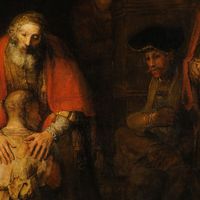
In this excerpt, the French monastic leader Frere Pierre Marie, shares an interpretation of Jesus as the true prodigal son—bringing all of us home with him: He, who is born not from human stock, or ...
Gaining spiritual life is conditional on suffering loss. We cannot measure our lives in terms of "gain"; they must be measured in terms of "loss." Our real capacity lies not in how...
Ancient Lens What can we learn from the historical context? Paul’s Relationship to Philippi There is practically no debate that Philippians was written by Paul. This letter is an intimate portray...
Transcendent God, you are the creator of time, You exist inside, outside, and around time and space. In your immeasurable power, you created and ordered the universe. Amazingly, you limited yourself b...
John 15:13, Philippians 2:6-7, Matthew 2:13-15, Matthew 5:44, Romans 5:8, 1 John 4:19, 2 Corinthians 9:15
Jesus – Savior: Praise You. Thank You. We’d never have done what You did We’d never give up so much for someone else who cared so little about us. … and we can’t imagine anyone doing it for us. But Yo...
Isaiah 9:6, Philippians 2:6-7, Luke 2:10-12, Micah 5:2, Matthew 2:1-2, 11, John 1:14
For this purpose, then, the incorporeal and incorruptible and immaterial Word of God entered our world. In one sense, indeed, He was not far from it before, for no part of creation had ever been witho...