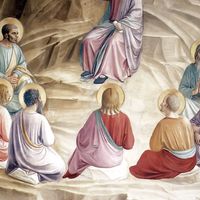
The disciples want to take Jesus aboard, and “immediately” they are already at their destination. Jesus’ spiritual destination, this chapter will teach us again and again, is believing disciples; futu...
The greatest issue facing the world today, with all its heartbreaking needs, is whether those who, by profession or culture, are identified as “Christians” will become disciples—students, apprentices,...
All: Holy Father, You are gracious to call us to Yourself. You are the King of kings, the Lord of Lords, and the Treasure of treasures, worthy of our lives. And just like Jesus called out His disciple...
John's Imprisonment, Jesus' Debut John the Baptist is as good as dead when we hear of Jesus’ splash onto the Galilean landscape in Mark 1:14. Mark tells us that Jesus arrives in Galilee preac...
Luke 10:38-42, Matthew 14:28-31, Philippians 3:13-14, Proverbs 4:25-27, James 1:6-8, Hebrews 12:1-2, Matthew 24:13
As we travel through the New Testament, it becomes clear that Jesus’ disciples often get distracted, almost like they have a case of spiritual attention deficit disorder. They quickly lose focus and w...
Preaching Commentary An Introduction from Luke Our passage begins with a note from the author (Luke) to his reader (Theophilus), which reminds us that Luke-Acts was initially meant to be two parts ...
Preaching Commentary John's Imprisonment, Jesus' Debut John the Baptist is as good as dead when we hear of Jesus’ splash onto the Galilean landscape in Mark 1:14. Mark tells us that Jesus a...
Cast your net again, We know this familiar foolishness So we cast it… we cast it wide, drag it deep, sweep it around the sea Suddenly! So many fish! The cry goes up with our hope It is the Lord! It...
Mark 6:1-13, Isaiah 11:2, 1 Peter 2:8, Mark 9:42-47, Mark 14:27-29, Mark 4:16-17, 1 Corinthians 1:23
Context As we read the opening chapters of Mark, it becomes clear that Mark is not primarily interested in telling us things about Jesus but showing Jesus to us. We see Jesus the healer, the exor...
Mark 6:1-13, Isaiah 11:2, 1 Peter 2:8, Mark 9:42-47, Mark 14:27-29, Mark 4:16-17, 1 Corinthians 1:23
Context As we read the opening chapters of Mark, it becomes clear that Mark is not primarily interested in telling us things about Jesus but showing Jesus to us. We see Jesus the healer, the exor...
Matthew 9:35-10, Deuteronomy 6:6-8, 1 Corinthians 3:7, Acts 1:null
Here Comes the Crowd Though he was challenging and divisive, Jesus always could draw a crowd. Some came because he had miraculously healed the lame or fed thousands. Others were there for the scandal...
Context Paul in Ephesus: His Third Missionary Journey This passage describes Paul’s arrival in Ephesus during his third missionary journey. He finds there some disciples who know only of John’s bapt...
Matthew 9:35-10:8, Deuteronomy 6:6-8, 1 Corinthians 3:7, Acts 1:null
Preaching Commentary Here Comes the Crowd Though he was challenging and divisive, Jesus always could draw a crowd. Some came because he had miraculously healed the lame or fed thousands. Others wer...
Preaching Commentary Context Paul in Ephesus: His Third Missionary Journey This passage describes Paul’s arrival in Ephesus during his third missionary journey. He finds there some disciples who k...
Luke 6:17-26, Matthew 5:1-12, Luke 4:33, Luke 16:19-31, Psalm 9:10, Psalm 12:6, Isaiah 41:17, Zephaniah 3:12, Luke 4:18, James 4:8-10, Luke 5:11, 28, Luke 14:25-33, 1 Peter 4:14, Jeremiah 17:5-10, Jeremiah 6:13
The context The beatitudes are one of the most well-known aspects of Jesus teaching. As in the more familiar account in Matthew (5:1-12), Luke presents these words as Jesus’ first public teaching; hi...
Luke 6:17-26, Matthew 5:1-12, Luke 4:33, Luke 16:19-31, Psalm 9:10, Psalm 12:6, Isaiah 41:17, Zephaniah 3:12, Luke 4:18, James 4:8-10, Luke 5:11, 28, Luke 14:25-33, 1 Peter 4:14, Jeremiah 6:13
Preaching Commentary The context The beatitudes are one of the most well-known aspects of Jesus teaching. As in the more familiar account in Matthew (5:1-12), Luke presents these words as Jesus’ fi...
Acts 4:13, 2 Timothy 2:2, Proverbs 27:17, Matthew 28:20, John 15:4, Luke 6:40, Mark 3:14
The act of “being with” someone requires patience and sacrifice. It means putting the other person’s wants and needs above our own and being willing to invest as much time as it takes to make the pers...
Colossians 1:28, Romans 12:2, Acts 11:26, Luke 9:23, John 17:3, Matthew 28:19-20
Jesus didn’t tell his friends, “Go into all the world and make Christians.” But he did tell them to go into the world and make disciples. In fact, the Bible uses the word disciple 269 times. As Dallas...
John 1:29-42, Revelation 17:14, Isaiah 52:13-15, Isaiah 53:, Ephesians 6:12
Summary of the Text Our lectionary text can be fairly easily broken into two major sections, with verses 29-34 concerned with John the Baptist testifying to Jesus’ ministry and verses 35-42 dealing w...
Colossians 3:16, Philippians 2:5-7, John 13:34-35, Matthew 11:29, Mark 8:34-35, Luke 9:23
Editor’s Note: The following illustration came from one of my own (Stu’s) sermons, as I was trying to help the congregation make a paradigm shift from the church as a building, to the people of God: ...
One of the first Bible study groups I ever attended was at the Sigma Chi fraternity house at Cornell University. We were a hodgepodge of academics, sorority girls, fraternity boys, star athletes, matu...
Non-discipleship is the elephant in the church; it is not the many moral failures, financial abuses, or amazing general similarity between Christians and non-Christians. These are only the effects of ...
While teaching on Jesus’ sending out of the disciples in Matthew 10, pastor John Ortberg uses the analogy of sports teams to describe the absurdity of Jesus’ description of the disciples as “sheep.” b...
Our mistake is to think that following Jesus consists in loving our enemies, going the ‘second mile,’ turning the other cheek, suffering patiently and hopefully—while living the rest of our lives just...
According to renowned Greek scholar Spiros Zodhiates, the Greek word from which we get our English word disciple means “not only to learn, but to become attached to one’s teacher and to become his fol...
A rabbi’s followers, known as his talmidim in Hebrew, went everywhere with him, not just to hang on his every word and learn theology from him. They followed him everywhere so that they could mimic wh...
Context This passage comes right at the end of the Gospel of John (save for just a few concluding verses). John 21 reads as a rather strange epilogue to this gospel, especially after chapter 20 has ...