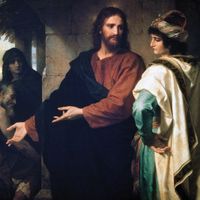
In the midst of a busy schedule of activities—healing suffering people, casting out devils, responding to impatient disciples, traveling from town to town, and preaching from synagogue to synagogue—we...
The ministry of Jesus does not end with his resurrection. In his ascension, he does not abandon his humanity. He is not the ascended Lord apart from everything that has happened between his incarnatio...
Matthew 14:19-20, John 9:6-7, Mark 2:3-4, John 13:4-5, Mark 1:40-42, Luke 2:7, John 1:14
The gospels are earthy. People are close to the earth. They travel here and there by foot. They eat the live heads of grain growing from the soil as they walk through the fields. They get grubby and h...
Genesis 12:1–3, Exodus 3:1–12, Isaiah 53:, Matthew 22:15–22 , John 4:1–42 , Acts 17:16–34
The world of Jesus was not the Old Testament Hebrew world. Like the United States now, Israel was multicultural, including a combination of Aramaic, Greek, and Roman influences. The people looked Jewi...
Matthew 25:35-40, John 8:1-11, Luke 19:1-10, John 4:1-26, John 8:10-11, Luke 19:10
In these acts of love Jesus created a scandal for devout, religious Palestinian Jews. The absolutely unpardonable thing was not his concern for the sick, the cripples, the lepers, the possessed . . . ...
1 Kings 19:11-13, Exodus 33:12-14, Isaiah 30:15-21, Mark 5:25-34, Mark 1:35-38, Psalm 46:10
Jesus knew his spiritual journey depended on responsiveness to God’s invitations. Although his job was the most crucial in human history, Jesus did not get compulsive, preoccupied or unable to practic...
Many of us may have wondered what types of prayers Jesus would have prayed during his time on planet earth. In his book Praying with the Church , Scot McKnight notes that Jesus and his disciples,...
Matthew 14:13, Matthew 4:1-11, Luke 6:12, Matthew 14:23, Mark 1:35, Mark 6:31, Luke 5:16, Matthew 17:1-9, Matthew 26:36-46
In the midst of an exceedingly busy ministry Jesus made a habit of withdrawing to “a lonely place apart” (Matt. 14:13; see also Matt. 4:1-11, Luke 6:12, Matt. 14:23, Mark 1:35, Mark 6:31, Luke 5:16, M...
John 14:6, Isaiah 55:8-9, Matthew 9:10-13, John 18:36, Luke 19:1-10
With a certain oversimplification we can trace easily enough the three options open to Jews in Jesus’ day. … First, the quietist and ultimately dualist option, taken by the writers of the Dead Sea Scr...
Matthew 14:13, Matthew 4:1-11, Luke 6:12, Matthew 14:23, Mark 1:35, Mark 6:31, Luke 5:16, Matthew 17:1-9, Matthew 26:36-46
In the midst of an exceedingly busy ministry Jesus made a habit of withdrawing to “a lonely place apart” (Matt. 14:13; see also Matt. 4:1-11, Luke 6:12, Matt. 14:23, Mark 1:35, Mark 6:31, Luke 5:16, M...
Mark 2:17, Luke 15:1-2, Luke 19:1-10, Matthew 11:28-30, Romans 5:8, 2 Corinthians 5:18-20
But it wasn’t just his new message that made Jesus irresistible. It was Jesus himself. People who were nothing like him liked him. And Jesus liked people who were nothing like him. Jesus invited unbel...
Luke 7:36-50, Romans 5:8, John 4:7-26, Matthew 11:19, Luke 19:5-10, Mark 2:15-17
Why did it disturb the religious leaders that Jesus ate with “sinners”? To eat with someone is an important symbol of fellowship. And in those days, the Jews had a rule: one is not to have such fellow...
Matthew 5:20, Romans 14:17, Luke 17:20-21, Matthew 28:18-20, Philippians 2:14-15
T. S. Eliot once described the current human endeavor as that of finding a system of order so perfect that we will not have to be good. The way of Jesus tells us, by contrast, that any number of syste...
Mark 14:10, Romans 8:32, Matthew 27:1-2, Luke 23:1-3, John 19:16
I was invited to visit a friend who was very sick. He was a man about fifty-three years old who had lived a very active, useful, faithful, creative life. Actually, he was a social activist who had car...
John 1:46, 1 Corinthians 1:26-29, Matthew 20:16, Luke 1:51-53, James 2:1-9, Matthew 11:25, Isaiah 52:2-3, Philippians 2:5-8
The world has always despised people from the wrong places and with the wrong credentials. We are always trying to justify ourselves. We need desperately to feel superior to others. And everything abo...
Leviticus 13:45-46, Isaiah 53:3-5, 2 Samuel 9:3, 6-7, Mark 1:40-42, Luke 7:37-38, John 20:27
Sociologist Erving Goffman wrote in his classic study Stigma: Notes on the Management of Spoiled Identity that the term stigma originated with the ancient Greeks, roughly during Jesus’ tim...
Colossians 1:15, John 1:14, Hebrews 1:3, John 14:9, Philippians 2:6-7
Origen, in the third century, had a great analogy. He told of a village with a huge statue—so immense you couldn’t see exactly what it was supposed to represent. Finally, someone miniaturized the stat...
2 Corinthians 10:1, Ephesians 4:2-3, Romans 12:3, Colossians 4:6, Matthew 23:11-12, Proverbs 11:2, James 1:19
In a statement created by Christian leaders across the world, the Lausanne Willowbank Report calls for church leaders to return to the humility and servanthood that Jesus manifested in His earthly min...
Revelation 17:14, Matthew 8:25-27, Mark 10:21-22, John 11:25-26, Luke 6:46-48, Isaiah 32:1-2
Though lords still exist today in some parts of the world, the term is used mostly as an honorary badge, so it’s easy to forget what the term even means. Throughout history, lords were rulers who had ...
Let’s call her Roberta; she was clearly near the end of a very long journey toward death’s door. Roberta’s cancer was a particularly nasty variety; by now it had eaten its way into most of her vital o...
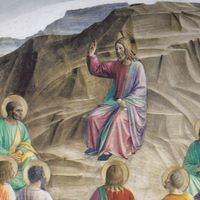
Pastor and Professor Darrell W. Johnson sets the scene for the Sermon on the Mount with great description. This could serve as a model for the beginning of a sermon on the S.O.M. They were sitting i...
In class I often use a show-and-tell example to illustrate the central point for the understanding of ministry. I invite a student to join me at the front of the class. I always pick a large, strongly...
Zechariah 9:9, Matthew 21:1-11, Mark 11:8-11, Luke 19:36-44, John 12:16-19
Judged in the light of any ordinary standards of regal splendor, military display, political campaigning, or effective advertising, it was a rather pathetic and anti-climactic affair. Jesus rode from ...
Zechariah 9:9, Matthew 21:1-11, Mark 11:8-11, Luke 19:36-44, John 12:16-19
The entrance into Jerusalem was an acted parable. It gave the faithful the sign they had been waiting for. It inaugurated the Master’s final mission to his people and was a fitting prelude to the days...
All of us share in what D. Elton Trueblood calls “the common ventures of life”—birth, marriage, work, death. Jesus, in his life and in his teaching, gave sacramental significance to these ordinary exp...
1 Kings 19:11-13 , Exodus 33:12-14, Isaiah 30:15 , Mark 1:35-38, Luke 5:15-16, Psalm 46:10
Jesus’ actions, in and of themselves, often make no sense unless we see them as responses to some hidden invitation—an invitation received from time spent alone with his Father. When Jesus was interru...
Zechariah 9:9, Matthew 21:1-11, Mark 11:8-11, Luke 19:36-44, John 12:16-19, Revelation 19:11-16
Two thousand years ago, triumphal processions were massively popular. It was, in all likelihood, the only chance most people would have to see the leaders and heroes of the day. For the Romans they t...
For most of us, Jesus’s world is a strange, foreign country. I don’t mean just the Middle East, a major international trouble spot then as now. I mean that people in his day and in his country thought...
Jesus also spent time—decades even—building stuff. Jesus was a tradesman. He is called a tekton (Mark 6:3), a builder who used his hands. God came to earth and apparently thought it worth his while to...
Matthew 25:35-40, James 1:27, Philippians 2:3-4, John 13:3-5, Micah 6:8, Isaiah 58:6-7, 1 John 3:18
An ancient legend tells of a well-respected rabbi who would vanish from his synagogue for a few hours each Sabbath. His mysterious absences sparked curiosity among his students, who wondered if their ...