Philippians 2:6-8, John 1:10-11, Isaiah 53:3-4, Matthew 11:19, Mark 15:34, Isaiah 53:12, Luke 15:20-24, Revelation 7:13-14
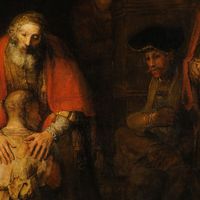
In this excerpt, the French monastic leader Frere Pierre Marie, shares an interpretation of Jesus as the true prodigal son—bringing all of us home with him: He, who is born not from human stock, or ...
Isaiah 9:6-7, Philippians 2:9-11, Mark 1:16-20, Matthew 11:28-30, John 10:10
H.G. Wells, himself an atheist, makes this point about the nature of greatness as it relates to Jesus: A historian like myself, who doesn’t even call himself a Christian, finds the picture centering...
John 1:18, John 6:46, Philippians 2:5-8, 1 Timothy 3:16, John 14:9, John 1:1-5, John 10:30, John 12:44-46, Colossians 1:15-20, Hebrews 1:
There is thus no God behind the back of Jesus Christ but only this God whose face we see in the face of the Lord Jesus. There is no deus absconditus , no dark inscrutable God, no arbitrary Deity ...
The most radical social teaching of Jesus was his total reversal of the contemporary notion of greatness. Leadership is found in becoming the servant of all. Power is discovered in submission. The for...
Matthew 5:20, Romans 14:17, Luke 17:20-21, Matthew 28:18-20, Philippians 2:14-15
T. S. Eliot once described the current human endeavor as that of finding a system of order so perfect that we will not have to be good. The way of Jesus tells us, by contrast, that any number of syste...
Introduction Our text falls within a larger section (Luke 16) in which Jesus deals head-on with questions of money, specifically the need to choose God over mammon (the worship of money), in other wo...
Introduction Our text falls within a larger section (Luke 16) in which Jesus deals head-on with questions of money, specifically the need to choose God over mammon (the worship of money), in other wo...
Matthew 13:31-33, 44-52, 2 Corinthians 12:9, Matthew 6:10, Matthew 5:3, 6, 10, 1 Corinthians 1:27, Matthew 26:28, Matthew 19:24, Philippians 3:7, Hebrews 12:2, Matthew 5:6, Matthew 28:19
preaching commentary The context The parables we hear this week are part of a collection of parables of the Kingdom collected by Matthew in chapter 13 of his gospel account. As with the Sermon on t...
Mark 14:36, Colossians 3:12, Matthew 6:1, Philippians 2:6-11, Romans 1:1, Isaiah 53:7, Mark 14:61, 1 Timothy 1:15, Ephesians 2:8, Luke 18:10-14, Matthew 5:23-24, Mark 7:8, Matthew 7:1-6, Matthew 16:52
Gentled by grace. That’s the incredible and inspiring story of Abba Moses the Black. He was a violent thief who became a humble and kind monk and one of the great Desert Fathers who served the Lord ...
Matthew 13:31-33, 2 Corinthians 12:9, Matthew 6:10, Matthew 5:3, 6, 10, 1 Corinthians 1:27, Matthew 26:28, Matthew 19:24, Philippians 3:7, Hebrews 12:2, Matthew 28:19
The context The parables we hear this week are part of a collection of parables of the Kingdom collected by Matthew in chapter 13 of his gospel account. As with the Sermon on the Mount (Matthew 5-7),...
Isaiah 1:1, 10-20, 2 Corinthians 12:9, Matthew 6:10, Matthew 5:3, 10, 1 Corinthians 1:27, 2 Corinthians 12:9, Matthew 26:28, Matthew 19:24, Philippians 3:7, Hebrews 12:2, Matthew 5:6, Matthew 28:19
The context The parables we hear this week are part of a collection of parables of the Kingdom collected by Matthew in chapter 13 of his gospel account. As with the Sermon on the Mount (Matthew 5-7),...
"Maundy" What? Maundy Thursday takes its name from the Latin version of John 13:34: "A new commandment I give to you, that you love one another: just as I have loved you, you also are ...
Luke 2:46-47, Psalm 119:105, John 15:10, Matthew 4:1-11, Philippians 2:8, James 1:22
It is easy to observe that Jesus was far from uneducated. He was perfectly at home both in holy scripture and in oral tradition, and he knew how to apply this scholarly heritage.
Matthew 5:18, John 1:1-14, Colossians 2:9, 1 Corinthians 15:20-22, Philippians 2:9-11, 2 Timothy 3:16-17, Hebrews 4:12, 2 Peter 1:20-21
The great American statesman and president Thomas Jefferson was a man of science who did not believe in miracles but really liked Jesus. Unfortunately, right next to Jesus’ ethical teachings are stori...
Pride, and its more serious cousin, narcissism, really shouldn’t have any place in leadership circles in the church. When I became a serious follower of Jesus at a teenager, Philippians 2 became one o...
A friend of mine, lecturing in a theological college in Kenya, introduced his students to “The Quest for the Historical Jesus.” This, he said, was a movement of thought and scholarship that in its ear...
John 12:1-8, Mark 14:1-2, Matthew 26:3-13, John 11:45, Luke 7:44-47, Matthew 26:6, Mark 14:3, Luke 7:40, John 11:50-53, Luke 24:41-43, John 21:10-14, Acts 10:40-41, John 12:7, Philippians 2:6-8, Romans 6:1-10
Introduction This narrative is slightly changed from the Synoptic accounts. Matthew and Mark’s Gospels place this narrative two days prior to the Passover (Matt: 26:6-13; Mark 14:1). Three Evangelist...
Preaching Commentary Paul’s Gospel In 1 Corinthians 1:17-25 we find the gospel that Paul preaches summarized in Christ’s crucifixion. Here in 2 Timothy 2:8, Paul’s gospel is encapsulated in Christ’...
Ancient Lens What can we learn from the historical context? Broader Context of Philippians Paul is concerned that Judaizers (those that require Christians to follow the Torah) are going to corrup...
Preaching Commentary Paul’s Gospel In 1 Corinthians 1:17-25 we find the gospel that Paul preaches summarized in Christ’s crucifixion. Here in 2 Timothy 2:8, Paul’s gospel is encapsulated in Christ’...
Philippians 2:3, Romans 12:10, Colossians 3:12, Galatians 5:13, 1 Peter 4:10, Matthew 23:11-12
What he [Jesus] was attempting to instill in his disciples was the attitude of a servant: humility and a willingness to put others ahead of oneself. In that culture, washing the feet of others would s...
Context Paul in Ephesus: His Third Missionary Journey This passage describes Paul’s arrival in Ephesus during his third missionary journey. He finds there some disciples who know only of John’s bapt...
John 12:1-8, Mark 14:1-2, Matthew 26:3-13, John 11:45, Luke 7:44-47, Matthew 26:6, Mark 14:3, Luke 7:40, John 11:50-53, Luke 24:41-43, John 21:10-14, Acts 10:40-41, John 12:7, Philippians 2:6-8, Romans 6:1-10
Preaching commentary Introduction This narrative is slightly changed from the Synoptic accounts. Matthew and Mark’s Gospels place this narrative two days prior to the Passover (Matt: 26:6-13; Mark ...
Preaching Commentary Context Paul in Ephesus: His Third Missionary Journey This passage describes Paul’s arrival in Ephesus during his third missionary journey. He finds there some disciples who k...
Almighty God–Father, Son and Holy Spirit: You tell us to pray with thanksgiving...and we do; giving thanks for Your daily provision and care, for the birth of a child, for new jobs and new friends, fo...
Preaching Commentary Background to the Letter and Passage Paul’s letter to the Ephesians was probably intended for wider distribution and use among the various churches around Ephesus. As such, the...
John 14:6, Philippians 3:8, Ephesians 2:13, 1 John 1:3, John 10:10, Hebrews 1:3, Colossians 1:15-17
Christianity at its core is not about subscription to a theological system or the authority of a sacred text or ethical perspectives, although they are all important. Christianity at its core is about...
Picture this: you are just about a year into your first call as a minister. Everything seems to be going swimmingly. You caught up with a seminary friend over the weekend and you slightly brag about h...
As a five-year-old at Christmas I remember how excited I was to get my first bike. It was a yellow BMX Huffy, a mean machine for a kid in the late 70s. It is one of my fondest memories because I remem...