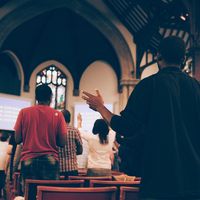
Since 1991, the adult population in the United States has grown by 15%. During that same period, the number of adults who do not attend church has nearly doubled, rising from 39 million to 75 million—...
What, then, does the author intend to communicate in verses 1-4? He proclaims that an authoritative and authentic high priest must both identify with and be distinct from those to whom he ministers. ...
Preaching Commentary What, then, does the author intend to communicate in verses 1-4? He proclaims that an authoritative and authentic high priest must both identify with and be distinct from those...
The success of every culture hinges not on big points of morality—there will always be issues like abortion or school prayer over which people differ—but on smaller values, like being considerate of o...
Ancient Lens What's the historical context? Dissolving the Divisions Generally speaking, the Psalms divide the people of the earth into two groups: “Israel” and “the nations.” Psalm 98 surpr...
Mark 8:36, Matthew 16:26, Romans 12:2, 1 Corinthians 1:26-31, Mark 4:18-19, Mark 10:43-44, Matthew 19:23-24, Matthew 6:19-21, 24-34, Luke 12:13-21, Luke 12:32-34, Mark 10:24-25, Hebrews 10:25
The defining problem driving people out is …just how American life works in the 21st century. Contemporary American life simply isn’t set up to promote mutuality, care, or common life. Rather, it is d...
John 4:23-24, Matthew 25:35-40, Romans 12:1-2, Psalm 96:7-9, Matthew 6:9-13, Hebrews 10:19-20
Ancient worship . . . does truth. All one has to do is to study the ancient liturgies to see that liturgies clearly do truth by their order and in their substance. This is why so many young people tod...
In the book of Hebrews (and elsewhere in the New Testament and theology, generally), the Greek and Jewish worlds collide. A funny parallel may be drawn between this and George's complete meltdown ...
Hebrews 12:5-11, Proverbs 3:11-12, Psalm 94:12, 1 Timothy 4:7-8, Philippians 3:12-14, Matthew 23:23-24, James 1:22-25, 1 Corinthians 9:24-27
While formally or structurally speaking, there are mechanisms of discipline operative in both the convent and the prison, in both the factory and the monastery, more specifically, these disciplines an...
We can learn a thing or two about discipleship and the discipline required of a disciple from our fourth-century monastic brothers and sisters. Like them, we do basic, ordinary activities every day. W...
John 14:6, Philippians 3:8, Ephesians 2:13, 1 John 1:3, John 10:10, Hebrews 1:3, Colossians 1:15-17
Christianity at its core is not about subscription to a theological system or the authority of a sacred text or ethical perspectives, although they are all important. Christianity at its core is about...
Philippians 3:20, John 17:28-38, John 18:36, Hebrews 13:14, Hebrews 11:8-10, Matthew 22:21, Romans 13:1, 1 John 2:16, James 4:4, Genesis 11:1-9
In 410 AD, Rome fell to the barbarian Germanic tribe known as the Visigoths, led by King Alaric. The idea of a “Christian” city (and empire) falling was a terrible defeat, not just militarily, but als...
What we need to realize, however, is that there is no such thing as autonomous or “self-grounding” knowledge. All systems of interpretation and all claims to true knowledge are ultimately grounded out...
Crises, and pressures for change, confront individuals and their groups at all levels, ranging from single people, to teams, to businesses, to nations, to the whole world. Crises may arise from extern...
Hebrews 11:39-40, Jeremiah 1:5, Philippians 3:14, Galatians 6:9, Matthew 25:21
In his landmark work, Habits of the Heart, the sociologist Robert Bellah describes thee distinct orientations people take with respect to their work. The first orientation is to see your work as a job...
By misinterpreting the Enlightenment and the corresponding rise of empiricism as an existential threat to Christian faith, many frightened Christians sequestered themselves into rooms of certitude.
Matthew 22:37-40, 2 Timothy 3:16-17, Hebrews 4:12, Psalm 119:105, Colossians 3:16, Matthew 4:4, Acts 17:11, John 5:39, 2 John 1:9, 1 Timothy 4:16
The Catholic Christians (Early Church) will neither speak nor endure to hear anything in religion that is a stranger to Scripture; it being an evil heart of immodesty to speak those things which are n...
Matthew 6:19-21, Luke 12:33-34, Luke 12:15, Hebrews 13:5, 1 Timothy 6:6-8, Luke 16:13, Matthew 6:24
Members of the Natomo family sit on the flat roof of their mud house in Mali, Africa, posing for their early morning photograph. Their earthly belongings are arrayed in front of them. Two kettles, pla...
Of true Christianity is not the truth of God, then the richest vintage that ever the world saw and the noblest wine of which it ever drank did grow up a thorn.
If we see more and further than they, it is not because of our own clear eyes or tall bodies, but because we are raised on high by their gigantic stature.
Participating in God’s glory-sharing life, then, happens in two contexts: scattered and gathered. Worship scattered is the Spirit-filled life of the Christian in the world, and worship gathered is the...
Galatians 6:10, Hebrews 11:13-16, 2 Corinthians 6:9-10, Matthew 5:44, 1 Peter 2:11-12, John 17:15-16
In an early Christian document known as the Epistle to Diognetus (c. A.D. 120-200), the author wrote a response to some propaganda circulating in the Roman Empire. People had spread false rumors about...
Ancient Lens What can we learn from the historical context? Context to the Letter While we don’t have a robust understanding of the context of Hebrews compared to, for example, many of Paul’s let...
Before Columbus crossed the Atlantic, many believed the world ended somewhere beyond Gibraltar, reflected in Spain’s royal motto: “Ne Plus Ultra,” meaning, “there is no more beyond.” But when Columb...
This is an age for spiritual heroes—a time for men and women to be heroic in faith and in spiritual character and power. The greatest danger to the Christian church today is that of pitching its messa...
Colossians 1:15-17, Hebrews 1:3, 2 Corinthians 4:4, John 1:18, John 10:30, John 14:9
Christmas in May I’m pretty sure it was Stephen Covey, back in the day ( The Seven Habits of Highly Effective People ) who originally said, “The main thing is to let the main thing be the main thing...