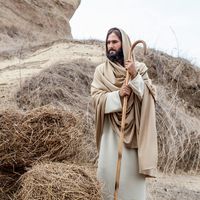
Robert C. McFarlane was a well-known businessman in the Los Angeles area. He had moved to California from Oklahoma in 1970, and within just a few days of his arrival—due to a disastrous misunderstandi...
After attending a conference in New York City, a pastoral colleague, Reid Kapple, was flying home to Kansas City on US Airways flight 745 when the plane suddenly lost cabin pressure. As the plane desc...
In A Life Worth Living , C.A. Roberts tells of meeting W.C. Coleman, founder of the Coleman Lantern Company. At eighty-four, Coleman recalled how he went from pauper to millionaire overnight. ...
Psalm 127:1–2, Matthew 25:14–30, Mark 6:3, Proverbs 22:29, 1 Kings 6:7, Exodus 31:1–5
Understanding Jesus’ economic interest and competency should not be surprising when we remember that Jesus spent the majority of his life on earth learning carpentry and running a small business. In J...
As we become more intentional about living according to our deepest desires, it becomes increasingly important to notice the effects of technology on our mind, our soul and our relationships. The ...
1 Kings 19:11-13, Exodus 33:12-14, Isaiah 30:15-21, Mark 5:25-34, Mark 1:35-38, Psalm 46:10
Jesus knew his spiritual journey depended on responsiveness to God’s invitations. Although his job was the most crucial in human history, Jesus did not get compulsive, preoccupied or unable to practic...
1 Kings 19:9–12, Exodus 33:14–16, Isaiah 30:15, Mark 6:31–32, Luke 10:38–42, Psalm 46:10
Another one of the great ironies of retreat is that overachievers tend to approach retreat as a place to get something done. I cannot tell you how many times I have gone on retreat seriously intending...
1 Kings 17:17-24, Numbers 20:7-12, 2 Kings 4:32-36, Mark 9:23-24 , James 5:14-15, Psalm 37:5
Agnes Sanford relates how, as the young wife of an Episcopal minister, her child came down with a serious ear infection. It lasted for six weeks while she prayed fearfully and fruitlessly. Then a ne...
1 Kings 3:5-14 , Joshua 24:14-15 , Nehemiah 6:1-4, Matthew 6:33 , Luke 10:42, Psalm 27:4
You have to decide what your highest priorities are and have the courage—pleasantly, smilingly, nonapologetically, to say “no” to other things. And the way you do that is by having a bigger “yes” burn...
Psalm 37:3-6 , Luke 12:16-21, Matthew 6:19-21 , Micah 6:6-8, 1 Kings 3:4-14
What do you want to achieve? Greater riches? Cheaper chicken? A happier life, a longer life? Is it power over your neighbors that you are after? Are you only running away from your death? Or are you s...
Exodus 18:13-24 , Leviticus 25:1-7, 1 Kings 19:4-12, Mark 6:30-32 , Luke 10:38-42, Psalm 46:10
[D]o you have margin in your life, like the white spaces between these words and the edges of the page? Having margin is about intentionally scheduling white space in your calendar to pray, rest, read...
I once heard a sermon that compared believers to commercials for God. “And God doesn’t need any bad commercials,” I remember the preacher saying. It stuck with me, and from then on I often made decisi...
Ambiguity may keep people up nights, but anyone seeking exquisite simplicity in his or her career ought to look for a non-leadership position. Leaders, by definition, have followers. Followers need di...
1 Kings 17:8-16, Exodus 16:16-18, Matthew 25:31-46 , Luke 10:25-37, 2 Corinthians 9:6-8, Psalm 41:1-3
Robert Lupton offers insight into the complexities of human impoverishment, reminding us that in spite of our best intentions sometimes our philanthropic efforts can yield unintended consequences: “Wh...
Genesis 2:15, 1 Kings 19:11-13, Ecclesiastes 3:1, Matthew 25:14-30, Luke 16:10-12, Psalm 16:5-6
When we speak of being the steward of our life, something else must be stressed. We are called to be the steward not of some ideal life or even the life we wish we had; rather we are called to be stew...
Gracious God, in our desire to achieve success and recognition, we have disregarded honesty and integrity in our speech and actions. Forgive us for our shortcuts, white lies, and dishonesty. Help us b...
"Psychology,” Dallas said quietly, “is the care of souls. The care of souls was once the province of the church, but the church no longer provides that care.” He paused. “The most important thing...
Vocation comes from the Latin voceru , to call, and means the work a man is called to by God. There are all different kinds of voices calling you to all different kinds of work, and the problem i...
Ephesians 5:16, Luke 12:15, 1 Timothy 6:6, 1 Kings 3:, Luke 12:21
An emissary from a learned society came to invite the eminent scientist Louie Agassiz to address its members. Agassiz refused on the grounds that lectures of this sort took up too much time that shoul...
Matthew 7:16-20, Matthew 7:16-20, Galatians 6:7-8, 1 Kings 10:1-10, Colossians 3:12-13, Matthew 25:14-30, Titus 2:7-8
One of my favorite things to do is to sit on the aft deck of a boat going across the ocean and just watch the wake. It is such a beautiful, ever-changing creation as the ship continues on its path. Yo...
Exodus 1:15–21, Daniel 3:16–18 , 1 Kings 3:16–28 , Matthew 4:1–11, Galatians 1:6–10, Psalm 73:
Pragmatism may be defined simply as the approach to reality that defines truth as “that which works.” The pragmatist is concerned about results, and the results determine the truth. The problem with t...
“Good work! You did your job well” (Matt. 25:23 MSG). That phrase reminds me of a story Joe Stowell told me about a time he met the president at the White House. Joe was president of Moody Bible Insti...
Gracious God, in our desire to achieve success and recognition, we have disregarded honesty and integrity in our speech and actions. Forgive us for our shortcuts, white lies, and dishonesty. Help us b...
Leviticus 19:15, Proverbs 18:17, 1 Kings 3:9, Matthew 7:1–5, John 7:24, Psalm 141:5
At a recent gathering of seminary professors, one teacher reported that at his school the most damaging charge one student can lodge against another is that the person is being “judgmental.” He found ...
One of the real problems in modern life is that people who are good at being civil lack strong convictions and people who have strong convictions lack civility.
Matthew 26:36-39, Acts 16:6-10, 1 Kings 3:5-14, Isaiah 6:1-8, Matthew 6:9-13
Within the Christian community this leads to a prominence of teaching on the will of God and how to know it. Russ Johnston draws upon his own wide experience to remark how this continues to be one of ...