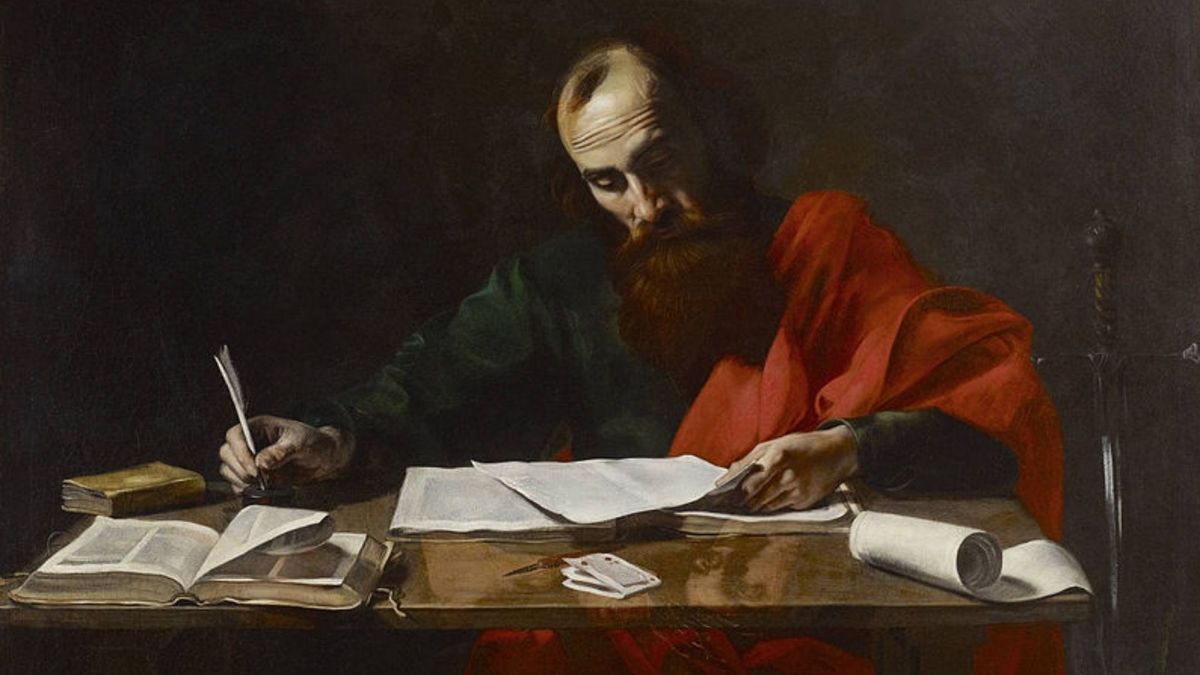
Introduction In Romans 10 we are encouraged to call upon the Lord. Lest we believe that our returning to God is ultimately a matter of works or our own merit, Paul wants us to see that repentance fi...
Context Standard Letter Format In all of Paul’s letter there is a basic format, which is based on the Greco-Roman form that was common at the time. Paul’s letters almost always include: Salutat...
Context Standard Letter Format In all of Paul’s letter there is a basic format, which is based on the Greco-Roman form that was common at the time. Paul’s letters almost always include: Salutat...
Vikings made long open-sea voyages when most European cultures were sticking close to the coasts. This allowed them to reach Iceland, Greenland, and even the tip of North America. But this was long be...
Ancient Lens What's the historical context? The Gospel in a Pagan World Paul writes this letter to the Christians in the church at Corinth, which he founded during his second missionary journ...
The apostle Paul said, “If then you have been raised with Christ, seek the things that are above, where Christ is, seated at the right hand of God. Set your minds on things that are above, not on thin...
Ancient Lens What's the historical context? The Gospel in a Pagan World Paul writes this letter to the Christians in the church at Corinth, which he founded during his second missionary journ...
Leader: In today’s Scripture reading, we will hear the story of a violent man named Saul, whose life was radically changed by Jesus. Before encountering Jesus, Saul persecuted Christians; after enco...
A little girl from Minneapolis reunited with her family after Sunday school looked upset. “I’m not going back!” she declared assertively. Surprised, her mother asked, “Why not?” The girl frowned and r...
St. Paul rejoices that his sufferings help to complete what is lacking of afflictions of Christ. This seems to mean two things. First that the Christian’s suffering (in this case the Apostle’s) are a ...
Saul of Tarsus did not intend to be a pilgrim when he set off to go from Jerusalem to Damascus. Indeed, why would any pilgrim make that journey? Pilgrims went to Jerusalem, not away from it. No: Saul,...
More than three-quarters of the uses of eucharisteo (thanksgiving) and charis (grace) in the New Testament occur in Paul’s writings. And, according to some scholars, Paul mentions thanksgiving more fr...
If God wished to give His people a series of letters like Paul’s, He prepared a Paul to write them, and the Paul He brought to the task was a Paul who spontaneously would write just such letters.
Adoption graphically and intimately describes the family character of Pauline Christianity, and is a basic description for Paul of what it means to be a Christian.
Paul’s labors were aimed, almost exclusively, at establishing churches and his writings were intended, almost exclusively, to encourage churches. . . . Solo-Christianity cannot exist. A member of Chri...