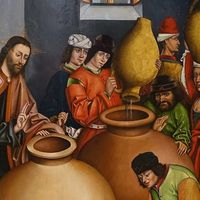
In the midst of a busy schedule of activities—healing suffering people, casting out devils, responding to impatient disciples, traveling from town to town, and preaching from synagogue to synagogue—we...
2 Timothy 3:14-4:5, 2 Timothy 3:14-17, 2 Timothy 4:1-5, Matthew 4:5, 1 Corinthians 9:13, Genesis 2:7, 1 Peter 2:4-5
Introduction In Paul’s second extant letter to his beloved Timothy, the passage of 3:10-4:5 records Paul’s final charge to Timothy. Calling on Timothy’s trust of Paul’s ministry and character (3:10-1...
2 Timothy 3:14-4:5, 2 Timothy 3:14-17, 2 Timothy 4:1-5, Matthew 4:5, 1 Corinthians 9:13, Genesis 2:7, 1 Peter 2:4-5
Preaching Commentary Introduction In Paul’s second extant letter to his beloved Timothy, the passage of 3:10-4:5 records Paul’s final charge to Timothy. Calling on Timothy’s trust of Paul’s ministr...
God–Father, Son and Holy Spirit; Lord of all our yesterdays, todays and tomorrows: thank you that we don’t need to be afraid of what’s coming because you’re already there ahead of us. Nothing takes yo...
Preaching Commentary Context Paul in Ephesus: His Third Missionary Journey This passage describes Paul’s arrival in Ephesus during his third missionary journey. He finds there some disciples who k...
Context Paul in Ephesus: His Third Missionary Journey This passage describes Paul’s arrival in Ephesus during his third missionary journey. He finds there some disciples who know only of John’s bapt...
Luke 13:31-35, Luke 11:51, Jeremiah 23:6, Deuteronomy 32:11, Ruth 2:12, Psalm 17:8, Isaiah 31:5
Ancient Lens What can we learn from the historical context? On the Road to Jerusalem Luke 13 begins with Jesus teaching on the nature of the kingdom of God and it concludes with our passage, in w...
Luke 13:31-35, Luke 11:51, Jeremiah 23:6, Deuteronomy 32:11, Ruth 2:12, Psalm 17:8, Isaiah 31:5
AIM Commentary Ancient Lens What can we learn from the historical context? On the Road to Jerusalem Luke 13 begins with Jesus teaching on the nature of the kingdom of God and it concludes with ...
Ancient Lens What can we learn from the historical context? From Noah to Abraham Last week, we looked at the story of Noah and how God became angry with the wickedness of the people, but decided ...
The ministry of Jesus does not end with his resurrection. In his ascension he does not abandon his humanity. He is not the ascended Lord apart from everything that has happened between his incarnation...
Leader: As Jesus began his earthly ministry, he said, “The Spirit of the Lord is upon me, because he has anointed me to proclaim good news to the poor.” People: Through the Holy Spirit, we too have ...
Matthew 14:13, Matthew 4:1-11, Luke 6:12, Matthew 14:23, Mark 1:35, Mark 6:31, Luke 5:16, Matthew 17:1-9, Matthew 26:36-46
In the midst of an exceedingly busy ministry Jesus made a habit of withdrawing to “a lonely place apart” (Matt. 14:13; see also Matt. 4:1-11, Luke 6:12, Matt. 14:23, Mark 1:35, Mark 6:31, Luke 5:16, M...
In my ministry I have noticed that when people are hurting, they frequently express their hope for Christ’s return – “Oh! I wish the Lord would return today!” But I have never heard anyone say, “Thing...
Matthew 25:35-40, John 8:1-11, Luke 19:1-10, John 4:1-26, John 8:10-11, Luke 19:10
In these acts of love Jesus created a scandal for devout, religious Palestinian Jews. The absolutely unpardonable thing was not his concern for the sick, the cripples, the lepers, the possessed . . . ...
Leader: King Jesus, you taught your disciples a great deal about your kingdom, and we confess that we have thought much more about our own kingdoms than about yours. In fact, you are the king over all...
Matthew 14:13, Matthew 4:1-11, Luke 6:12, Matthew 14:23, Mark 1:35, Mark 6:31, Luke 5:16, Matthew 17:1-9, Matthew 26:36-46
In the midst of an exceedingly busy ministry Jesus made a habit of withdrawing to “a lonely place apart” (Matt. 14:13; see also Matt. 4:1-11, Luke 6:12, Matt. 14:23, Mark 1:35, Mark 6:31, Luke 5:16, M...
Luke 4:18-19, Acts 10:38, John 14:12, Luke 10:9, Matthew 12:28, Luke 7:22
In what sense, then, did Jesus declare that the Kingdom of God was present? Our answer must at least begin with His own answer to John: “The blind see, the lame walk, the lepers are cleansed, the deaf...
Preaching Commentary The Fast-Paced Gospel “Immediacy” defines the Gospel of Mark’s rendition of Jesus’ ministry. Its fast pace reads like a comic strip of heroic proportions. Before one miraculous...
Thus, from the standpoint of the gospels, the mighty deeds of Jesus, healings and exorcisms alike, were the product of the power which flowed through him as a holy man. His powers were charismatic, th...
The Fast-Paced Gospel “Immediacy” defines the Gospel of Mark’s rendition of Jesus’ ministry. Its fast pace reads like a comic strip of heroic proportions. Before one miraculous event is over another ...
The servant role was completed in Jesus. Though there were auspicious sings that preceded and accompanied his birth, preparing the world for the majestic and kingly, the birth of Jesus itself was of t...
During the life of Jesus on earth, the word He chiefly used when speaking of the relations of the disciples to Himself was: “Follow me.” When about to leave for heaven, He gave them a new word, in whi...
Genesis 12:1–3, Exodus 3:1–12, Isaiah 53:, Matthew 22:15–22 , John 4:1–42 , Acts 17:16–34
The world of Jesus was not the Old Testament Hebrew world. Like the United States now, Israel was multicultural, including a combination of Aramaic, Greek, and Roman influences. The people looked Jewi...
Intertwined Narratives Jesus’ encounters with Jairus’ daughter and the bleeding woman are sandwiched together with the intention that the two narratives would unlock and help to interpret the other....
Mark 13:1-8, Mark 11:, Mark 12:, Ezekiel 10:18-19, Ezekiel 11:22-23
Context In the Book of Mark Mark 13 contains the “Olivet Discourse,” also called “the Little Apocalypse.” At the beginning of this chapter (and our reading), the disciples marvel at Herod’s spectacu...
Intertwined Narratives Jesus’ encounters with Jairus’ daughter and the bleeding woman are sandwiched together with the intention that the two narratives would unlock and help to interpret the other....
1 Peter 5:7, 2 Corinthians 1:3-4, Psalm 34:15, Mark 4:39-40, Luke 7:12-15, Mark 10:46-52, Luke 19:5-6
Lord—You’re the God who notices. You notice a desperate woman who touches Your garments in a crowd. You notice a lonely, little tax-collector in a tree. You notice a blind man on the roadside, a widow...
Matthew 14:19-20, John 9:6-7, Mark 2:3-4, John 13:4-5, Mark 1:40-42, Luke 2:7, John 1:14
The gospels are earthy. People are close to the earth. They travel here and there by foot. They eat the live heads of grain growing from the soil as they walk through the fields. They get grubby and h...
We should also note that while Jesus had the biggest work assignment in human history-he had been invited to "save the world"-he never spent weeks writing a vision statement with steps for s...