Leviticus 25:10-17, Deuteronomy 15:7-11, Amos 5:11-15, James 82:, Luke 4:18-19
There is no social evil, no form of injustice whether of the feudal or the capitalist order which has not been sanctified in some way or other by religious sentiment and thereby rendered more impervio...
So it is that in most Western industrialized countries church and society have lost their identity, religion has become more and more a private affair, and morality has become secular. This process af...
God built into the creation a variety of cultural spheres, such as the family, economics, politics, art, and intellectual inquiry. Each of these spheres has its own proper "business" and nee...
We have the same biblical texts that earlier generations of Christians thought their way through, of course, but our reflections are shaped by six unique factors. (1) Especially in the Anglo-Saxon wo...
One of the areas often missed in a lot of Christian apologetics is the social setting in which a person encounters the gospel. For example, it is far easier to espouse "rational arguments" f...
Exodus 5:1-21, 1 Samuel 8:4-22, Isaiah 1:10-17 , Matthew 23:23-28 , Galatians 3:26-29, Psalm 146:3-9
One of the gravest dangers to the Christian faith is its wholesale appropriation of the larger culture. When this happens, the citizens of those places cannot recognize the difference between their cu...
Politics draws lines between people; in contrast, Jesus’ love cuts across those lines and dispenses grace. That does not mean, of course, that Christians should not involve themselves in politics. It ...
Gracious God, we don’t live as Christ did. Although You give us specific instructions for an ordered way of life that stands out from the rest of the world, we settle for lukewarm Christianity. Our li...
Though American Christians do have genuine opponents in the public square and in elite institutions, they have often been their own worst enemies, making disastrous political compromises and looking t...
Acts 17:6, Revelation 5:9-10, Galatians 3:28, Romans 8:17, Matthew 5:3
The kingdom of God turns the Darwinist narrative of the survival of the fittest upside down (Acts 17:6–7). When the church honors and cares for the vulnerable among us, we are not showing charity. We ...
The problem was that . . . Christian values were always more popular in American culture than the Christian gospel. That’s why one could speak of “God and country” with great reception in almost any e...
John 2:15-16, Romans 12:2, Ephesians 2:1-2, John 15:18-19, James 4:4
The world, though, is protean: each generation has the world to deal with in a new form. World is an atmosphere, a mood. It is nearly as hard for a sinner to recognize the world’s temptations as it is...
Culture is like gravity. We never talk about it, except in physics classes. We don’t include gravity in our weekly planning processes. No one gets up thinking about how gravity will affect their day. ...
More often than not, park-it-at-the-door thinking [about religious faith] has less to do with hostility to faith than with the avoidance of risk, for many employer’s fear that any hint of religion is ...
A Christianity that reflects its culture, whether that culture is Smith College or NASCAR, only lasts as long as it is useful to its host . That’s because it’s, at root, idolatry, and people turn from...
Micah 6:6–8, 1 Samuel 8:4–9, Jeremiah 7:1–7, John 8:36, Romans 12:2, Psalm 146:3–5
Nothing illustrates evangelicals’ infatuation with politics more clearly than a story related by a Christian lawyer. Considering whether to take a job in the nation’s capital, he consulted with the le...
John 6:15, Matthew 5:38-39, Matthew 7:24-27, Matthew 15:1-9, Matthew 16:13-17, John 18:36, Luke 4:18-19, Acts 9:1-9, Psalm 1:
Jesus is understood in the light of the assumptions which control our culture. When “reason” is invoked as a parallel or supplementary authority to “Scripture” and “tradition,” what is happening is t...
The Rule of Benedict is a document that has ordered the life of Benedictine monks for 1500 years. That remarkable document, written by Saint Benedict of Nursia, instructs the monks in how they are to ...
Philippians 3:14, Matthew 7:13-14, 1 Peter 5:8-9, Colossians 2:8, Psalm 1:1-3, Ephesians 4:14, Romans 12:2
Perhaps the most intense place to experience drifting is commonly known as the EAC, the East Australian Current. If you’ve ever seen the Disney Pixar film Finding Nemo, you’ve been exposed to the EAC,...
Not very long ago, “culture” commonly referred to what is now meant by “high culture.” For instance, we might have said, “She has such a cultured voice.” If a person read Shakespeare, Goethe, Gore Vid...
The Book of Acts, like the Gospels before it, shows us that Christianity thrives when it is, as Kierkegaard put it, a sign of contradiction . Only a strange gospel can differentiate itself from the wo...
Psalm 2:10-11, John 18:36, Matthew 5:13-16, Jeremiah 29:7, Micah 6:8, 1 Samuel 15:22
We can’t separate what we believe in the political arena from who we are in Christ and what obedience to God demands...That said, not every tenet of Christianity should become the law of the state. We...
On April 12, 1963, eight clergy—two Methodist bishops, two Episcopal bishops, one Roman Catholic Bishop, a Rabbi, a Presbyterian, and a Baptist—wrote a letter addressed to the citizens of Alabama. Thi...
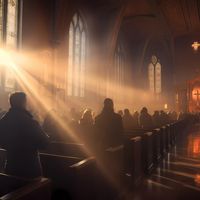
The cathedral lay at the center of a society. Its structure told the story of the Christian narrative and the human journey. In its shadow people were formed inside a story about how life was best liv...
Isaiah 49:6, Revelation 7:9, John 3:16, Galatians 3:28, Romans 10:12, Acts 1:8, Matthew 28:19-20
The Gospel as such has no native country. He who goes out humbly with Christ in the world of all races will perpetually discover the multiple, but constant, relevance of what he takes. It takes a whol...
Will Christians turn once again toward an approach that imposes its will on the rest of society? By doing so we would betray our founder, who resisted a temptation to authority over “all the kingdoms ...
1 Samuel 24:10-12, Proverbs 16:8, Romans 12:17-18, Psalm 72:1-4, Micah 6:8, Matthew 5:13-16
When in conflict we should demonstrate that our public witness is more important than winning a political battle. This means that if our side has to do something unloving or corrupt to win, then it’s ...
The first phrase, “be fruitful and multiply,” means to develop the social world: build families, churches, schools, cities, governments, laws. The second phrase, “subdue the earth,” means to harness t...