Ancient Lens What can we learn from the historical context? Broader Context of Philippians Paul is concerned that Judaizers (those that require Christians to follow the Torah) are going to corrup...
Ancient Lens What can we learn from the historical context? Paul’s Relationship to Philippi There is practically no debate that Philippians was written by Paul. This letter is an intimate portray...
Ancient Lens What can we learn from the historical context? A letter of friendship Paul’s letter to the Philippians is from Paul and his companions to the saints in Philippi. It is a letter fro...
Introduction Believed to be some of Paul’s last words of his long ministry, 2 Tim. 4:6ff are Paul’s closing remarks to his beloved disciple, Timothy. Imprisoned in Rome by this point, Paul concludes ...
2 Corinthians 12:2-10, Philippians 2:7-8, John 1:11, John 14:2-3
Inexpressible Things This chapter of Paul’s Corinthian correspondence is rich indeed, revealing so much about Paul and his relationship to the Corinthian church, a church which he himself founded. Bu...
This Maundy Thursday guide combines and updates two previous guides. "Maundy" What? Maundy Thursday takes its name from the Latin version of John 13:34: "A new commandment I give to...
Exodus 12:1-14, Psalm 31:9-16, Philippians 2:5-11, Mark 11:1-11
AIM commentary Ancient lens What's the historical context? Original Passover If you frequent any web sites that have thread or message board formats, you occasionally run into the acronym “...
Preaching Commentary Introduction Believed to be some of Paul’s last words of his long ministry, 2 Tim. 4:6ff are Paul’s closing remarks to his beloved disciple, Timothy. Imprisoned in Rome by this...
John 12:1-8, Mark 14:1-2, Matthew 26:3-13, John 11:45, Luke 7:44-47, Matthew 26:6, Mark 14:3, Luke 7:40, John 11:50-53, Luke 24:41-43, John 21:10-14, Acts 10:40-41, John 12:7, Philippians 2:6-8, Romans 6:1-10
Introduction This narrative is slightly changed from the Synoptic accounts. Matthew and Mark’s Gospels place this narrative two days prior to the Passover (Matt: 26:6-13; Mark 14:1). Three Evangelist...
John 12:1-8, Mark 14:1-2, Matthew 26:3-13, John 11:45, Luke 7:44-47, Matthew 26:6, Mark 14:3, Luke 7:40, John 11:50-53, Luke 24:41-43, John 21:10-14, Acts 10:40-41, John 12:7, Philippians 2:6-8, Romans 6:1-10
Preaching commentary Introduction This narrative is slightly changed from the Synoptic accounts. Matthew and Mark’s Gospels place this narrative two days prior to the Passover (Matt: 26:6-13; Mark ...
Psalm 118:, Matthew 21:9, Mark 11:9, Luke 19:38, John 12:13, Ezra 5:null, Ezra 6:, Mark 12:10-11, 1 Peter 2:5, Deuteronomy 7:8, 1 Corinthians 1:26-27, 1 Corinthians 12:9, Romans 8:26-27, Philippians 2:8-10
Introduction This guide is often read on Palm Sunday and it is especially interesting when read in light of Jesus' triumphal entry into Jerusalem. All the gospels include a quotation of part of P...
Preaching Commentary Introduction As we use our acronym (AIM) for understanding the lectionary Psalm 118:1-2, 19-29, we should remind ourselves that the lectionary texts are chosen very carefully t...
Mark 1:4-11, Isaiah 40:3, Mark 2:7, Philippians 2:7, Isaiah 53:null, Hebrews 4:15, 2 Corinthians 8:9, Mark 1:1-3
Enter John the Baptist John the Baptist enters the stage in Mark 1 as the “voice of one crying in the wilderness,” (Isaiah 40:3) whose message and ministry is to “prepare the way of the Lord.” Mark d...
Preaching Commentary Background to the Letter and Passage Paul’s letter to the Ephesians was probably intended for wider distribution and use among the various churches around Ephesus. As such, the...
2 Corinthians 12:2-10, Philippians 2:null, Philippians 2:7-8, John 1:11, John 14:2-3
Preaching Commentary Inexpressible Things This chapter of Paul’s Corinthian correspondence is rich indeed, revealing so much about Paul and his relationship to the Corinthian church, a church which...
Mark 1:4-11, Mark 1:1-3, Isaiah 40:3, Mark 2:7, Philippians 2:7, Isaiah 53:null, Hebrews 4:15, 2 Corinthians 8:9
Preaching Commentary Enter John the Baptist John the Baptist enters the stage in Mark 1 as the “voice of one crying in the wilderness,” (Isaiah 40:3) whose message and ministry is to “prepare the w...
The bad news was that a friend’s leg was severed in a gruesome automobile accident. The good news was that it was surgically reattached. A few months later she asked if I wanted to see her scar. I swa...
2 Thessalonians 1:3, 1 Peter 2:2, 2 Peter 3:18, Mark 5:19, Luke 14:23, Acts 1:8, Matthew 5:16, Luke 8:16, Philippians 2:15, Mark 4:1-20, Luke 8:4-8, Psalm 12:6-8, Psalm 91:1-2, Luke 8:39, 1 Peter 2:9, 1 John 5:13, 2 Corinthians 5:1, 2 Timothy 3:1-5
The word “Christian” has lost much of its meaning in our culture. It means “Christ in one.” As you communicate the Good News of Jesus Christ, this is what God expects of a Christian: He expects us to...
2 Corinthians 11:2, Acts 13:50, James 4:13-15, Philippians 2:3-4, Romans 12:17-19, 1 Peter 2:23, 2 Timothy 4:2, 1 Peter 5:2-3, John 21:15-17, 2 Corinthians 4:5, 1 Corinthians 2:1-5
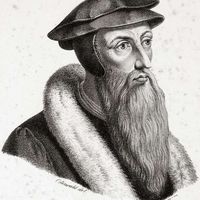
The Protestant Reformer John Calvin (1509-1564) arrived in Geneva to lead the city’s church in 1536, but not, as we might imagine, to universal acceptance. Rather, there was significant resistance and...
Philippians 2:5-11, Philippians 4:19, Matthew 6:31-33, Matthew 7:11, Luke 12:22-34
Humble and Loving King, you have created us and provide for our every need. And yet, we grasp for that which we don’t need. We try to take what does not belong to us. We attempt to take your place on ...
Where there’s humility there is majesty; where there’s weakness, there’s might; where there is death, there’s life. If you want to get these things don’t disdain those.
Have you ever noticed geese soaring across the sky in a V formation? Scientists have uncovered the wisdom behind this flight pattern: as each bird flaps its wings, it creates an uplift for the one beh...
The problem is not recognizing the importance of the individual. The problem is the glorification of the individual. When the individual self is glorified over the greater good of the community, right...
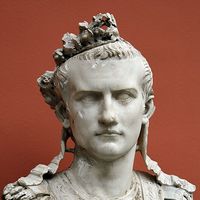
During each full moon, believing himself equal to the Roman gods, the Roman emperor Caligula would summon the moon goddess to share his bedchamber. When he asked Aulus Vitellius—a member of the Roman ...
Dr. Albert Schweitzer, who famously left his renowned practice in Switzerland to become a medical missionary in Africa, was hosting a group of European visitors at his hospital in Lambarene, French Eq...
Though Christ was by nature divine, Christ did not cling to equality with God, but in utter self-emptying, took the form of a slave, and was born as a human. God have mercy. Appearing in h...
John 1:1-18, Hebrews 1:1-2, Galatians 4:4-5, 1 Timothy 1:15-17, John 3:16-17, Philippians 2:6-8, Colossians 1:15-17
He who wraps the heavens in clouds wrapped round himself a towel. He who pours the water into the rivers and pools tipped... water into a basin. And he before whom every knee bends in heaven and on ea...
The reason we fight with each other, and often believe the worst about each other, is that we form convictions about things for which we care deeply. Unfortunately, we all care deeply about different ...
Internal conflict is not only dangerous—it can threaten the long-term flourishing of any organization, including the church. According to tradition, during the Battle of Trafalgar, Lord Horatio Nelson...