2 Corinthians 11:2, Acts 13:50, James 4:13-15, Philippians 2:3-4, Romans 12:17-19, 1 Peter 2:23, 2 Timothy 4:2, 1 Peter 5:2-3, John 21:15-17, 2 Corinthians 4:5, 1 Corinthians 2:1-5
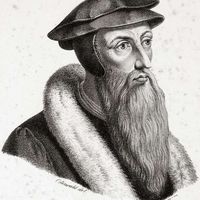
The Protestant Reformer John Calvin (1509-1564) arrived in Geneva to lead the city’s church in 1536, but not, as we might imagine, to universal acceptance. Rather, there was significant resistance and...
A strong church once inscribed these words on an archway leading to the churchyard. Over time, two things happened: the church lost its passion for Jesus and His gospel, and ivy began to grow on the a...
Context Paul in Ephesus: His Third Missionary Journey This passage describes Paul’s arrival in Ephesus during his third missionary journey. He finds there some disciples who know only of John’s bapt...
Preaching Commentary Context Paul in Ephesus: His Third Missionary Journey This passage describes Paul’s arrival in Ephesus during his third missionary journey. He finds there some disciples who k...
preaching commentary The Servant Leader The servant leader is the hero of this text. And the example, par excellence, is the Apostle Paul. He has never shied away from holding himself up as a pe...
2 Corinthians 12:2-10, Philippians 2:null, Philippians 2:7-8, John 1:11, John 14:2-3
Preaching Commentary Inexpressible Things This chapter of Paul’s Corinthian correspondence is rich indeed, revealing so much about Paul and his relationship to the Corinthian church, a church which...
Ancient Lens What can we learn from the historical context? Broader Context of Philippians Paul is concerned that Judaizers (those that require Christians to follow the Torah) are going to corrup...
The Servant Leader The servant leader is the hero of this text. And the example, par excellence, is the Apostle Paul. He has never shied away from holding himself up as a person to be imitated, as...
2 Corinthians 12:2-10, Philippians 2:7-8, John 1:11, John 14:2-3
Inexpressible Things This chapter of Paul’s Corinthian correspondence is rich indeed, revealing so much about Paul and his relationship to the Corinthian church, a church which he himself founded. Bu...
Preaching Commentary Background to the Letter and Passage Paul’s letter to the Ephesians was probably intended for wider distribution and use among the various churches around Ephesus. As such, the...
Background to the Letter and Passage Paul’s letter to the Ephesians was probably intended for wider distribution and use among the various churches around Ephesus. As such, there is no particular cri...
Context of Galatians I still remember my intro to New Testament class in college and the professor discussing Paul’s letter to the Galatians. All of Paul’s other letters begin with words of adoration...
Preaching Commentary Paul’s Gospel In 1 Corinthians 1:17-25 we find the gospel that Paul preaches summarized in Christ’s crucifixion. Here in 2 Timothy 2:8, Paul’s gospel is encapsulated in Christ’...
Matthew 13:31-33, 44-52, 2 Corinthians 12:9, Matthew 6:10, Matthew 5:3, 6, 10, 1 Corinthians 1:27, Matthew 26:28, Matthew 19:24, Philippians 3:7, Hebrews 12:2, Matthew 5:6, Matthew 28:19
preaching commentary The context The parables we hear this week are part of a collection of parables of the Kingdom collected by Matthew in chapter 13 of his gospel account. As with the Sermon on t...
Preaching Commentary Paul’s Gospel In 1 Corinthians 1:17-25 we find the gospel that Paul preaches summarized in Christ’s crucifixion. Here in 2 Timothy 2:8, Paul’s gospel is encapsulated in Christ’...
Isaiah 1:1, 10-20, 2 Corinthians 12:9, Matthew 6:10, Matthew 5:3, 10, 1 Corinthians 1:27, 2 Corinthians 12:9, Matthew 26:28, Matthew 19:24, Philippians 3:7, Hebrews 12:2, Matthew 5:6, Matthew 28:19
The context The parables we hear this week are part of a collection of parables of the Kingdom collected by Matthew in chapter 13 of his gospel account. As with the Sermon on the Mount (Matthew 5-7),...
Matthew 13:31-33, 2 Corinthians 12:9, Matthew 6:10, Matthew 5:3, 6, 10, 1 Corinthians 1:27, Matthew 26:28, Matthew 19:24, Philippians 3:7, Hebrews 12:2, Matthew 28:19
The context The parables we hear this week are part of a collection of parables of the Kingdom collected by Matthew in chapter 13 of his gospel account. As with the Sermon on the Mount (Matthew 5-7),...
Will the Real Jesus, Please Stand Up? Quite a few years have passed since I sat through a systematic theology class and had the professor pitch a variety of difficult to hit balls at us regarding the...
Preaching Commentary Introduction Believed to be some of Paul’s last words of his long ministry, 2 Tim. 4:6ff are Paul’s closing remarks to his beloved disciple, Timothy. Imprisoned in Rome by this...
Introduction Believed to be some of Paul’s last words of his long ministry, 2 Tim. 4:6ff are Paul’s closing remarks to his beloved disciple, Timothy. Imprisoned in Rome by this point, Paul concludes ...
Ancient Lens What can we learn from the historical context? Philippian Joy During Division and Persecution For an in-depth description of the context of Paul’s letter to the Philippians, see last...
Preaching Commentary Ancient Lens What can we learn from the historical context? Israel’s State of Mind The Book of Isaiah is a remarkable accounting of the history of the relationship people o...
Ancient Lens What can we learn from the historical context? Paul’s Relationship to Philippi There is practically no debate that Philippians was written by Paul. This letter is an intimate portray...
Context Layers The responsible interpretation of any biblical text requires one to consider multiple levels of context, but these contextual strata are especially important to define and explore in ...
John 12:1-8, Mark 14:1-2, Matthew 26:3-13, John 11:45, Luke 7:44-47, Matthew 26:6, Mark 14:3, Luke 7:40, John 11:50-53, Luke 24:41-43, John 21:10-14, Acts 10:40-41, John 12:7, Philippians 2:6-8, Romans 6:1-10
Preaching commentary Introduction This narrative is slightly changed from the Synoptic accounts. Matthew and Mark’s Gospels place this narrative two days prior to the Passover (Matt: 26:6-13; Mark ...
Mark 1:4-11, Mark 1:1-3, Isaiah 40:3, Mark 2:7, Philippians 2:7, Isaiah 53:null, Hebrews 4:15, 2 Corinthians 8:9
Preaching Commentary Enter John the Baptist John the Baptist enters the stage in Mark 1 as the “voice of one crying in the wilderness,” (Isaiah 40:3) whose message and ministry is to “prepare the w...
Check out our video discussion of the text with the author, Austin D. Hill. Click here to view! Ancient Lens What can we learn from the historical context? Exile and Catastrophe There is deba...
Preaching Commentary Introduction As we use our acronym (AIM) for understanding the lectionary Psalm 118:1-2, 19-29, we should remind ourselves that the lectionary texts are chosen very carefully t...
AIM Commentary Check out our video discussion of the text with the author, Austin D. Hill. Click here to view! Ancient Lens What can we learn from the historical context? Exile and Catastrop...
Mark 1:4-11, Isaiah 40:3, Mark 2:7, Philippians 2:7, Isaiah 53:null, Hebrews 4:15, 2 Corinthians 8:9, Mark 1:1-3
Enter John the Baptist John the Baptist enters the stage in Mark 1 as the “voice of one crying in the wilderness,” (Isaiah 40:3) whose message and ministry is to “prepare the way of the Lord.” Mark d...