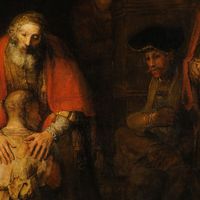
Reflection In Isak Dinesen’s 1958 short story, “Babette’s Feast,” we see Babette Hersant, a 19th century French chef from Paris, seek political asylum in the Jutland region of Denmark in the home of ...
Romans 8:, John 14:15-18, John 14:23, Acts 1:8, John 16:13, Mark 13:11, Luke 21:14-15, Luke 12:11-12, Matthew 10:19-20, 1 John 4:1
The indwelling Spirit shall teach him what is of God and what is not. This is why sometimes we can conjure up no logical reason for opposing a certain teaching, yet in the very depth of our being aris...
Context Signs and Dialogue There’s a reoccurring pattern in Johns’s Gospel in which Jesus performs a sign, which is followed by dialogue and then commentary from Jesus that provides the theological ...
Mark 6:14-29, Mark 6:6b-13, Mark 6:30, John 1:14, Mark 6:30, Mark 8:29, Mark 6:4, Mark 8:27-28, 1 Kings 19:1-10, 1 Kings 21:17-26, Mark 9:13, Romans 7:18-25, Mark 14:1-12
Context Between the Sending and Return of the Twelve The fate of John the Baptist appears in a Markan ‘sandwich,’ where the story is told almost as a detour between the sending (ἀποστέλλω) of the ...
Leader: "A great crowd had come to the feast. When they heard that Jesus was coming to Jerusalem, they took the branches of the palm trees and went out to meet him, and cried out," People: ...
John 6:1-21, 2 Samuel 11:1-15, Psalm 14:, Ephesians 3:14-21, 2 Kings 4:42-44, Psalm 145:10-18
Ancient Lens What's the historical context? A New Kind of Feast A mountain, a gathering of thousands, and a great feast make for a classic ancient worship scene. Add in the frequency of loca...
Matthew 26:14-27:66, Luke 22:3, John 13:2, Mark 14:10-11, Luke 22:3-4
AIM Commentary Ancient Lens What can we learn from the historical context? Betrayal and Supper Judas’ motivation for betraying Jesus is not clear in Matthew and Mark. It certainly was not the ...
Ancient Lens What can we learn from the historical context? Back to Bethany The trans-Jordan village of Bethany was the place in which Jesus’ ministry began. It is now the place in which our text...
This guide has been updated and expanded. Our Maundy Thursday guide for 2026 on John 13 incorporates this material along with additional commentary, illustrations, and discussion questions. Check ...
Jesus’ first sign Uniquely, John refers to Jesus’ miracles as “signs,” and changing the water into wine is recorded as being Jesus’ first sign. The use of the term “sign” is significant in that Joh...
John 6:1-21, 2 Samuel 11:1-15, Psalm 14:, Ephesians 3:14-21, 2 Kings 4:42-44, Psalm 145:10-18
Ancient Lens What's the historical context? A New Kind of Feast A mountain, a gathering of thousands, and a great feast make for a classic ancient worship scene. Add in the frequency of loca...
John 18:1-19:42, John 18:1-40, John 19:1-42, Matthew 27:24, Psalm 22:15, Psalm 69:21, Matthew 25:21
Preaching Commentary Introduction The lectionary text from John is an exceedingly long passage, but covers the main events that we commemorate on Good Friday. For that reason, I am going to break u...
John 18:1-19:42, Exodus 4:13-15, Romans 5:null, Matthew 27:24, Psalm 22:15, Psalm 69:21, Matthew 25:21
Preaching Commentary The lectionary text from John is an exceedingly long passage, but covers the main events that we commemorate on Good Friday. For that reason, I am going to break up the text int...
At this point in the Gospel we move out of the streets into the quiet of a room. “The noise of the cosmos has died away: the stillness of night prevails” (Bultmann). And yet, in [that] quiet room, Jes...
John 18:1-19:42, John 18:1-40, John 19:1-42, Matthew 27:24, Psalm 22:15, Psalm 69:21, Matthew 25:21
The lectionary text from John is an exceedingly long passage, but covers the main events that we commemorate on Good Friday. For that reason, I am going to break up the text into manageable chunks. I ...
John 13:1-17, 31b-35, Exodus 12:1-14, Psalm 116:, 1 Corinthians 11:23-26
Introduction Only John’s Gospel tells us that Jesus washed his disciple’s feet during his last meal with them. The other texts for this day remember the Passover and the context it sets for Jesus’s w...
John 13:1-17, 31B-35, John 13:31-35, Exodus 12:4, Psalm 116:6, 1 Corinthians 11:23
John's Account of the Last Supper This passage is most often preached on on Maundy Thursday (or Holy Thursday). By our modern measure, “Thursday” would also include Gethsemane and other events of...
Jesus’ first sign Uniquely, John refers to Jesus’ miracles as “signs,” and changing the water into wine is recorded as being Jesus’ first sign. The use of the term “sign” is significant in that Joh...
Brothers and sisters, God does not leave us in our distress. He does not abandon us to our devilish decisions. While we choose to starve ourselves on a diet of our own making and choosing that leads t...
Ancient Lens What can we learn from the historical context? Back to Bethany The trans-Jordan village of Bethany was the place in which Jesus’ ministry began. It is now the place in which our text...
Hear the words of our Lord Jesus Christ on the night before his death: “Do you understand what I have done to you? You call me Teacher and Lord, and you are right, for so I am. If I then, your Lord a...
Introduction Only John’s Gospel tells us that Jesus washed his disciple’s feet during his last meal with them. The other texts for this day remember the Passover and the context it sets for Jesus’s w...
Mark 6:14-29, Mark 6:6b-13, Mark 6:30, John 1:14, Mark 6:30, Mark 8:29, Mark 6:4, Mark 8:27-28, 1 Kings 19:1-10, 1 Kings 21:17-26, Mark 9:13, Romans 7:18-25, Mark 14:1-12
Between the Sending and Return of the Twelve The fate of John the Baptist appears in a Markan ‘sandwich,’ where the story is told almost as a detour between the sending (ἀποστέλλω) of the Twelve (6...
Mark 6:30-34, 53-56, Mark 6:6b-13, Mark 6:30, John 1:14, Mark 6:30, Mark 8:29, Mark 6:4, Mark 8:27-28, 1 Kings 19:1-10, 1 Kings 21:17-26, Mark 9:13, Romans 7:18-25, Mark 14:1-12
Context Mark 6 began with Jesus being rejected in his hometown and sending the Twelve on a ‘mission trip.’ At the high point of the disciples’ success, Mark interrupts his narrative to relay the deat...
John 1:1-14, John 1:1, Genesis 1:null, Colossians 1:null
God expressed Himself J.B. Phillips paraphrases the first line of John 1:1, “At the beginning God expressed himself ”. God’s word is more than mere speech. His word is action. When God speaks in Gen...
Zechariah 9:9, Matthew 21:1-11, Mark 11:8-11, Luke 19:36-44, John 12:16-19
The entrance into Jerusalem was an acted parable. It gave the faithful the sign they had been waiting for. It inaugurated the Master’s final mission to his people and was a fitting prelude to the days...
John 1:43-51, John 20:29, 1 Corinthians 13:12, John 4:29, John 4:42
Context Jesus' Ministry Begins This passage is from the first chapter of John’s gospel and describes the beginning of Jesus’ ministry—fitting for the beginning of a new year. A congregation foll...
Context This passage comes right at the end of the Gospel of John (save for just a few concluding verses). John 21 reads as a rather strange epilogue to this gospel, especially after chapter 20 has ...
Ancient Lens What can we learn from the historical context? A Hard Saying There are (at least) two leaps that Jesus’s listeners have to make here. One is the reality of the incarnation and the o...
Philippians 2:6-8, John 1:10-11, Isaiah 53:3-4, Matthew 11:19, Mark 15:34, Isaiah 53:12, Luke 15:20-24, Revelation 7:13-14
In this excerpt, the French monastic leader Frere Pierre Marie, shares an interpretation of Jesus as the true prodigal son—bringing all of us home with him: He, who is born not from human stock, or ...