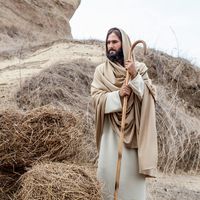
Walter Brueggemann writes that the movement of the psalms is from orientation to disorientation and then to new orientation. The psalms give us a language for transformation in desert spaces: we move ...
Isaiah 26:3, 2 Corinthians 5:17, John 15:5, Colossians 3:3-4, Luke 9:23, Philippians 2:3-5, Romans 12:1-2
The word eccentric comes from a combination of the Greek terms ex (out of) and kentron (center). When combined, ekkentros means “out of center.” The term gained currency in the late Middle Ages, when ...
Matthew 6:22-23, 2 Corinthians 3:18, Luke 11:34, Matthew 13:13, 1 John 2:16
James Elkins talks about how even the sense of sight is more complicated than we might believe: “Our eyes are not ours to command; they roam where they will and then tell us they have only been where ...
The road to character often involves moments of moral crisis, confrontation, and recovery. When they were in a crucible moment, they suddenly had a greater ability to see their own nature. The everyda...
Progress means getting nearer to the place you want to be. And if you have taken a wrong turning, then to go forward does not get you any nearer. If you are on the wrong road, progress means doing an ...
I must register a certain impatience with the faddish equation, never suggested by me, of the term identity with the question, “Who am I?” This question nobody would ask himself except in a more or le...
John 5:6, Isaiah 43:18-19, 2 Peter 1:3, James 1:4, Hebrews 12:1-2
Remember Miss Haversham in Charles Dickens's Great Expectations? Her entire life was defined by the fact that she was jilted on her wedding day. People can become very attached to their pain and i...
Relational congruence is the ability to be fundamentally the same person with the same values in every relationship, in every circumstance and especially amidst crisis. It is the internal capacity to ...
Individual disasters, too, very largely follow upon human choices, our own or those of others. And whether or not they do in a particular case, the situations in which we find ourselves are never as i...
We long to see our lives whole, to know that they matter. We wonder whether our many activities might ever come together in a way of life that is good for ourselves and others. Lacking a vision of a l...
Genesis 41:39-43 , Exodus 4:22-23, 2 Samuel 9:6-7, Luke 15:17-24, Galatians 4:6-7 , Psalm 103:13-14
When he [the prodigal son] found himself desiring to be treated as one of the pigs, he realized that he was not a pig but a human being, a son of his father. . . . Once he had come again in touch with...
We're not trying to prove the character of God through science. That's a bad idea. What I'm trying to do is clear away the misunderstandings, the debris that prevent people from accepting ...
God is light; in him there is no darkness at all. But often, we claim to have fellowship with him and yet walk in the darkness. By doing so, we lie and do not live out the truth. We too easily claim t...
Isaiah 1:13-17, 1 Samuel 8:19-20 , Hosea 4:6, Romans 12:2, Matthew 23:27-28, Psalm 78:5-8
By failing to come to grips with how cultural dysfunctions deeply impact the health of the church, our leaders will continue to fail to discern an essential reality concerning the nature of change: Cu...
Summary of the Text As a child, I was attracted to the dark recesses of my neighborhood. I was drawn to the dim lit woods that were away from the din of the suburbia in which I was raised. I even rem...
What we know matters, but who we are matters more. Being rather than knowing requires showing up and letting ourselves be seen. It requires us to dare greatly, to be vulnerable.
Fine feelings, new insights, greater interest in 'religion' mean nothing unless they make our actual behavior better.... When we Christians behave badly, or fail to behave well, we are making ...
As I walked out the door toward the gate that would lead to my freedom, I knew if I didn't leave my bitterness and hatred behind, I'd still be in prison.
To frame is to put a language boundary around our experience. It is to name what happens in particular ways, to say how we see the world, and to see the world how we say it is. Framing includes tellin...
Matthew 6:1-6, Deuteronomy 6:4-9, Matthew 23:4, 5, 13-36, Mark 12:42, Luke 21:2, Isaiah 58:6, Joel 2:1-2, 12-17
Ancient Lens What can we learn from the historical context? "Hear O Israel..." The Shema (Deuteronomy 6:4-9) commands the Israelites to love the Lord their God with heart, soul, and m...
When Jesus came to earth, demons recognized him, the sick flocked to him, and sinners doused his feet and head with perfume. Meanwhile he offended pious Jews with their strict preconceptions of what G...
Jesus never appears desperate, manipulative, or controlling, as if when people didn’t agree with him, his feelings would be hurt. He is mission-focused and others-centered to his deepest core.
Genesis 18:1–8, 2 Kings 4:8–10 , Ruth 2:10–12, Luke 8:43–48 , Matthew 15:21–28, Psalm 145:8–9
I have a friend who says he wants to write a book on the life of Jesus and call it “a theology of interruptions.” Because, he says, so many of the things that Jesus said or did in the Gospel stories h...
Proverbs 16:18–19, 2 Chronicles 26:16–21 , Daniel 4:28–37, Luke 14:7–11, Philippians 2:3–8, Psalm 25:8–9
At eighteen, a self-assured Benjamin Franklin returned to Boston, the city he had fled just seven months earlier. Dressed in a fine new suit, with a watch on his wrist and a pocket full of coins, he p...
Preaching Commentary Drama at Its Finest The transfiguration is theatrical. It is drama at its finest. The mountain peak as the stage of the performance, the appearance of the greatest dramatis per...
Drama at Its Finest The transfiguration is theatrical. It is drama at its finest. The mountain peak as the stage of the performance, the appearance of the greatest dramatis personae known to Israel, ...