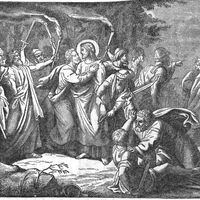
Mark 14:10, Romans 8:32, Matthew 27:1-2, Luke 23:1-3, John 19:16
I was invited to visit a friend who was very sick. He was a man about fifty-three years old who had lived a very active, useful, faithful, creative life. Actually, he was a social activist who had car...
With the global coronavirus pandemic in spring 2020, life stopped. Overwhelmed by the threat of a disease we couldn’t stop and for which we didn’t have the hospital capacity, everyone moved work and s...
Proverbs 16:9, Jeremiah 29:11, John 15:1-27, Proverbs 3:5-6, Galatians 2:20, Matthew 6:25-34
In their excellent book Invitation to a Journey , M. Robert Mulholland and Ruth Haley Barton describe the foundation of life as being spiritual in nature. This means we are constantly be “formed” s...
The Old Testament was the lens through which the early church saw the life of Jesus. Holding the Old and New Testaments together offers us a kind of “binocular” vision instead of the lack of depth per...
Luke 20:27-38, Mark 12:18-27, Matthew 22:23-33, 1 Corinthians 15:, Genesis 2:18-25
Ancient Lens What can we learn from the historical context? Worldviews Collide In this passage, we have a clash of worldviews similar to some that we find today. While the Sadducees were not mat...
One of the beauties of the lectionary is that it brings together the Old and New Testament in the way the first Christians saw them. It gives us “binocular” vision instead of the lack of depth percept...
Luke 20:27-38, Mark 12:18-27, Matthew 22:23-33, 1 Corinthians 15:, Genesis 2:18-25
Ancient Lens What can we learn from the historical context? Worldviews Collide In this passage, we have a clash of worldviews similar to some that we find today. While the Sadducees were not mat...
Ephesians 2:8-9, Galatians 3:24, Romans 8:3-4, Acts 9:1-19, Matthew 5:17
The law is harsh and cannot help us to receive forgiveness. In Craddock Stories, a collection of outstanding stories by Fred Craddock, is the following account with one who could understand law, but ...
We all go through desert seasons and have the opportunity to determine how we will respond. The cyclical frustrations I faced in regard to my desire for control, fear, and the longing to feel chosen w...
We delude ourselves into believing that if we can just get everything done, if we can only tie up all the loose ends, if we can even once get ahead of the crush, we will prove our worth and establish ...
Exodus 32:1-6 , 1 Samuel 4:3-10, Isaiah 40:18-25, Matthew 16:13-20, Acts 5:1-11 , Psalm 115:4-8
A. W. Tozer once wrote, Left to ourselves we tend immediately to reduce God to manageable terms. We want to get Him where we can use Him, or at least know where He is when we need Him. We want a ...
Luke 22:27, Matthew 23:11, Philippians 2:5-7, Galatians 5:13, John 13:14-15, Mark 10:45
The way most of us serve keeps us in control. We choose whom, when, where and how we will serve. We stay in charge. Jesus is calling for something else. He is calling us to be servants. When we make t...
In Luke Norsworthy’s book, God over Good , he describes the curiosity of a new friend whose bedroom was, to use his own words, “immaculate.” At the time this seemed strange, but in hindsight, and wit...
Matthew 11:28-30, Galatians 5:1, Deuteronomy 30:19-20, 1 Corinthians 10:23, John 10:10
When every option is available to us, we don’t actually have freedom; we tend to shut down. I experienced what sociologists call choice overload (or paralysis) and decision fatigue. If you’ve ever tri...
Deuteronomy 30:19–20, Joshua 24:14–15, 1 Kings 18:21, John 14:6, Matthew 11:28–30, Psalm 119:105
When every option is available to us, we don’t actually have freedom; we tend to shut down. I experienced what sociologists call choice overload (or paralysis) and decision fatigue. If you’ve ever tri...
Jeremiah 17:10, Mark 4:1-41, Mark 4:19, Matthew 13:22, Matthew 13:18-23, Luke 10:25-37
Thomas Merton describes those who never experience the gift of a contemplative life. His explanation for why some people never experience this can be found in his book, New Seeds of Contemplation: [T...
1 Peter 5:7, Matthew 6:27, Psalm 46:10, Romans 15:13, Song of Solomon 2:11-13
If we want to turn in the direction of what is life giving, we are going to have to let go of Winter. “’Let go’ of the dark, which you wrap yourself in like a straitjacket, and let in the light. Stop ...
Too many people hear the word capacity and assume it’s a limitation. They assume their capacity is set—especially if they’re beyond a certain age. People give up on the idea that their capacity or the...
Revelation 5:9-10, Matthew 26:53-54, Isaiah 53:10, John 19:11, 1 Corinthians 1:18, Romans 5:6-8, Colossians 1:19-20
The point is this. If you want to know what it means to talk about God being ‘in charge of’ the world, or being ‘in control’, or being ‘sovereign’, then Jesus himself instructs you to rethink the noti...
Proverbs 3:5, John 6:1-15, Matthew 14:13-21, Mark 6:31–44, Luke 9:12–17, Matthew 15:32–39, Mark 8:1-9, 1 Peter 5:7, Philippians 4:19, Matthew 6:25-34
Heavenly Father, we confess that our trust in you wavers and that we are fickle in our reliance. We see you provide great things where we see little possibility; but when storms come in life, we quic...
Mark 8:36, Matthew 16:26, Romans 12:2, 1 Corinthians 1:26-31, Mark 4:18-19, Mark 10:43-44, Matthew 19:23-24, Matthew 6:19-21, 24-34, Luke 12:13-21, Luke 12:32-34, Mark 10:24-25, Hebrews 10:25
The defining problem driving people out is …just how American life works in the 21st century. Contemporary American life simply isn’t set up to promote mutuality, care, or common life. Rather, it is d...
1 Corinthians 3:11, Romans 11:36, James 4:13-15, Jeremiah 29:11, Matthew 6:33
Lord, our King, we confess our tendency to build homes and kingdoms that are more for us than they are for you. We confess the pride we take in our own security and ability to protect and to preserve....
Ephesians 4:32, Hebrews 11:1, Luke 6:38, James 1:18-20, Matthew 9:36
Generous Lord Jesus We confess that we do not receive others with compassion. We object to being interrupted And respond with anger or frustration. We confess that we do not share generously Not trus...
In this short poem, the psychologist Daniel Goleman (the developer of the concept of Emotional Intelligence (E.Q.)) builds on the work of R. D. Laing’s “knots.” The poem is a helpful reminder that our...