John 14:26, 2 Peter 1:12-13, Philippians 4:8, Luke 2:19, Proverbs 2:1-5
Memory researchers reveal that memory and creativity are linked historically. The Latin root inventio is the basis for two words in our modern English vocabulary: inventory and invention. And to ...
Romans 14:17, Luke 7:34, Isaiah 25:6, Proverbs 3:10, John 2:10, 1 Timothy 4:4
Without question, the greatest invention in the history of mankind is beer. Oh, I grant you that the wheel was also a fine invention, but the wheel does not go nearly as well with pizza.
1 Kings 17:8-16, Daniel 6:16-23, Matthew 14:25-31, Luke 4:33-36, John 2:1-11 , Psalm 77:14-15
It is impossible to use electric light and the wireless and to avail ourselves of modern medical and surgical discoveries, and at the same time believe in the New Testament world of spirits and miracl...
The current understanding of the physical sciences, which contrasts sharply with the strictly mechanical perspectives prevalent in earlier centuries, aligns closely with the New Testament’s portrayal ...
2 Corinthians 13:14, Hebrews 1:3, Ephesians 1:13-14, Colossians 2:9, Matthew 28:19, John 1:14
Thou hast but two rare cabinets full of treasure, The Trinity, and Incarnation: Thou hast unlockt them both, And made them jewels to betroth The work of thy creation Unto thy self in everlasting pleas...
Genesis 1:, John 1:1-3, Colossians 1:16-17, Hebrews 1:2-3
The Father created the world by a miracle; it is difficult to express its measure. Letters cannot contain it, letters cannot comprehend it. Jesus created for the hosts of Christendom, with miracles...
The day will come when, after harnessing the winds, the tides and gravitation, we shall harness for God the energies of Love. And on that day, for the second time in the history of the world, man will...
John 1:14, Luke 2:4-7, Matthew 4:1-2, John 4:6-7, Mark 4:38-39, John 4:6
Man's maker was made man that He, Ruler of the stars, might nurse at His mother's breast; that the Bread might hunger, the Fountain thirst, the Light sleep, the Way be tired on its journey; th...
Matthew 5:18, John 1:1-14, Colossians 2:9, 1 Corinthians 15:20-22, Philippians 2:9-11, 2 Timothy 3:16-17, Hebrews 4:12, 2 Peter 1:20-21
The great American statesman and president Thomas Jefferson was a man of science who did not believe in miracles but really liked Jesus. Unfortunately, right next to Jesus’ ethical teachings are stori...
A doctor, an engineer, and a politician were arguing as to which profession was older. “Well,” argued the doctor, “without a physician mankind could not have survived, so I am sure that mine is the ol...
Every creator, from a child with Play-Doh to Michelangelo, learns that creation involves a kind of self-limiting. You produce something that did not exist before, yes, but only by ruling out other opt...
Exodus 17:1-7, 2 Kings 4:1-7, John 2:1-11, Matthew 25:14-30 , Psalm 19:1
John Dryden (1631–1700), an English critic and poet laureate, often skipped classes at Westminster School in London and rarely prepared his lessons. One day, when tasked with writing a poem on the gos...
Exodus 32:null, 1 Timothy 4:16, 1 John 4:1-4, 2 Corinthians 11:14-15, Proverbs 3:5-6, Matthew 7:1-2, James 1:19
On a cold January day, a forty-three-year-old man was sworn in as the chief executive of his country. By his side stood his predecessor, a famous general who, fifteen years earlier, had commanded his ...
Names in the ancient world were associated with identity, role and function. Consequently, naming is a typical part of the creation narratives. The Egyptian Memphite Theology identifies the Creator as...
John 1:14, Colossians 1:19, John 2:11, Acts 2:22, Matthew 9:35
Just as every natural event is the manifestation at a particular place and moment of Nature's total character, so every particular Christian miracle manifests at a particular place and moment the ...
One key difference between much of the early church vs. the church of today (at least in the West) was the belief in, and regular experience of, miracles. As Joel Green, the noted professor and writer...
Genesis 2:15, Exodus 20:15, Matthew 25:14-30, John 10:10, Psalm 139:13-14, 1 Corinthians 6:19-20
There’s a charming story about a little boy who made a gingerbread man. He poured his heart into crafting it, carefully decorating it with candy eyes and a cheerful smile. It was his creation, and he ...
John 1:1-4, Philippians 2:6-8, Colossians 1:16-17, Isaiah 7:14, Micah 5:12, 2 Corinthians 8:9, Luke 2:11-12
He by whom all things were made was made one of all things. The Son of God by the Father without a mother became the Son of man by a mother without a father. The Word Who is God before all time became...
They say that in Martin Luther’s class on Genesis, a smart aleck student asked, “Dr. Luther, since you know so much about the book of Genesis, tell us: what was God doing all that time before God crea...
The very nature of light provides contrast. In juxtaposition, differing levels of light illuminate in extraordinary ways, helping us to see what we’ve been missing. In the late 1400s, the art world ma...
John 1:14, Philippians 2:6-8, Luke 2:6-7, 1 Corinthians 1:27-29, Matthew 18:2-4
The incarnation is a kind of vast joke whereby the Creator of the ends of the earth comes among us in diapers... Until we too have taken the idea of the God-man seriously enough to be scandalized by i...
Titus 3:5, Luke 19:1-10, Romans 12:2, Ezekiel 36:26, 2 Corinthians 5:17, John 3:3
To get a man soundly saved it is not enough to put on him a pair of new breeches, to give him regular work, or even to give him a University education. These things are all outside a man, and if the i...
Tony Reinke does a great job capturing the deep ambivalence many of us feel about our smartphones in this short excerpt: This blasted smartphone! Pesk of productivity. Tenfold plague of beeps and ...
John 1:14, Luke 1:26-38, Luke 2:1-7, Matthew 2:1-12, Luke 2:8-20, Philippians 2:6-8
It is here, in the thing that happened at the first Christmas, that the most profound unfathomable depths of the Christian revelation lie. God became man; nothing in fiction is so fantastic as this tr...
C.S. Lewis on the Incarnation: We catch sight of a new key principle—the power of the Higher, just in so far as it is truly Higher, to come down, the power of the greater to include the less. . . . ...
Philippians 2:8, Luke 23:34, Matthew 27:46, John 19:17-18, Isaiah 50:6, John 19:1
Jesus learned how to walk, stumbled and fell, cried for his milk, sweated blood in the night, was lashed with a whip and showered with spit, was fixed to a cross, and died whispering forgiveness on us...
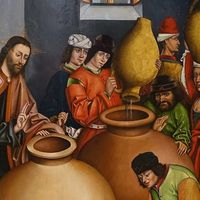
The transformation from water to wine is of course meant by John to signify the effect that Jesus can have, can still have today, on people’s lives. He came, as he says later, that we might have life...