The New Testament portrays Christ, the Son, as actively “sustain[ing] all things by his powerful word” (Hebrews 1:3), serving as the cohesive force of the universe. A.H. Strong expands on this idea: ...
I was in a bird store one day, struck up a conversation with the owner, and I mentioned in passing while looking at a hummingbird feeder that I had one but couldn’t attract hummers. He asked where we ...
In the book of Hebrews (and elsewhere in the New Testament and theology, generally), the Greek and Jewish worlds collide. A funny parallel may be drawn between this and George's complete meltdown ...
Colossians 1:15, John 14:6, John 8:12, 2 Corinthians 4:6, John 14:9, Hebrews 1:3, John 1:14
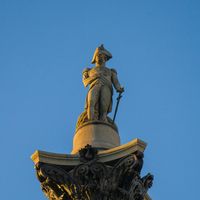
At Trafalgar Square in the city of London stands a statue of Lord Nelson. Resting atop a tall pillar, it towers too high for passersby to distinguish his features. For this reason, about forty years a...
John 14:9, Colossians 1:15, Hebrews 1:3, 2 Corinthians 4:4-6, Luke 19:10
A student of mine, Josiah Brown, oversees the student outreach team. He and some of our students go to youth groups to teach the youth about Christian spiritual formation. They talk about what formati...
Isaiah 9:6-7, Hebrews 1:1-3, Colossians 1:15-17, Philippians 2:6-8, John 3:16-17, John 1:1-4, Luke 1:30-35
In the ancient world, a place where the veil between the earthly and spiritual was easily pierced, rumors and gossip about great leaders being born of the gods, especially amongst royals, was somewhat...
Colossians 1:15, John 1:14, Hebrews 1:3, John 14:9, Philippians 2:6-7
Origen, in the third century, had a great analogy. He told of a village with a huge statue—so immense you couldn’t see exactly what it was supposed to represent. Finally, someone miniaturized the stat...
Colossians 1:15-17, Hebrews 1:3, John 1:1-5, Matthew 16:13-20, John 14:6, Acts 4:12
There’s Republican Jesus who is against tax increases and activists judges, and for family values and owning firearms. There’s Democrat Jesus who is against Wall Street and Walmart, and for reducing ...
John 1:14, John 14:9, Revelation 1:12-16, Philippians 2:5-7, 2 Corinthians 4:4, Hebrews 1:3, Colossians 1:15-16
My friend and colleague Keas Keasler, who teaches a class on spiritual formation, recently asked the class to close their eyes and picture God. After a few moments he had them open their eyes and, if ...
Colossians 2:9, John 14:9, Hebrews 1:3, John 1:18, 2 Corinthians 4:6, Philippians 2:6-7
By the way, I have terrible eyesight. When I don’t have my glasses on, I can see shapes and forms and colors, but not much else. And that’s sort of what I think it’s like to look at God without Jesus....
Julian of Norwich was a fourteenth-century mystic-theologian who maybe understood the belovedness of creation and new creation better than anyone. In the fifth chapter of her book Revelations of Divin...
John 14:6, Philippians 3:8, Ephesians 2:13, 1 John 1:3, John 10:10, Hebrews 1:3, Colossians 1:15-17
Christianity at its core is not about subscription to a theological system or the authority of a sacred text or ethical perspectives, although they are all important. Christianity at its core is about...
True Christianity is a fight. . . .There is a vast quantity of religion current in the world which is not true, genuine Christianity. It passes muster; it satisfies sleepy consciences; but it is not g...