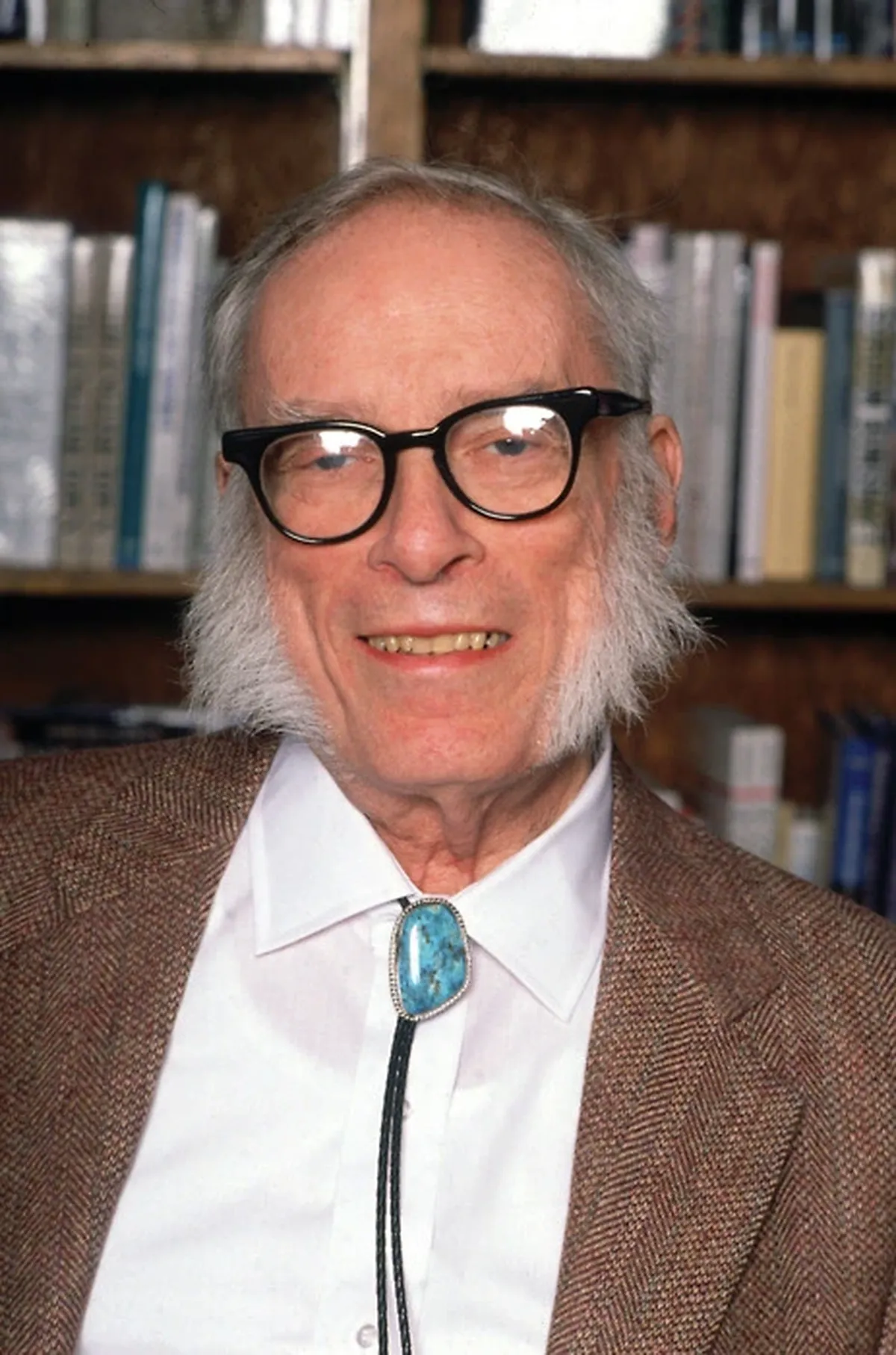
Isaac Asimov
Isaac Asimov (1920–1992) was a Russian-born American author, professor, and biochemist, best known for his groundbreaking work in science fiction and popular science writing. He is widely regarded as one of the "Big Three" science fiction writers, alongside Arthur C. Clarke and Robert Heinlein. Asimov's works have had a profound influence on both the science fiction genre and public understanding of science.
Born in Petrovichi, Russia, Asimov's family emigrated to the United States when he was a child. He grew up in Brooklyn, New York, and developed an early love of reading and writing, particularly in the fields of science and fantasy. Asimov went on to earn a Ph.D. in biochemistry from Columbia University and spent much of his career as a professor at Boston University School of Medicine.
Asimov's literary career spanned more than five decades, during which he wrote or edited over 500 books, including novels, short stories, and nonfiction works. His most famous contributions to science fiction include the Foundation series, which explores the rise and fall of a future galactic empire, and the Robot series, which introduced his famous "Three Laws of Robotics." These works helped to shape modern science fiction by incorporating complex ideas about human nature, technology, and society.
In addition to his fiction, Asimov wrote extensively on topics ranging from chemistry to history, making science accessible to the general public. His books, such as The Intelligent Man's Guide to Science and Asimov's New Guide to Science, helped to popularize science and bring a deeper understanding of scientific concepts to a broad audience.
Isaac Asimov's legacy as a prolific writer and his contributions to both science fiction and nonfiction continue to inspire readers and thinkers today. His work remains a touchstone for both literary and scientific exploration.


