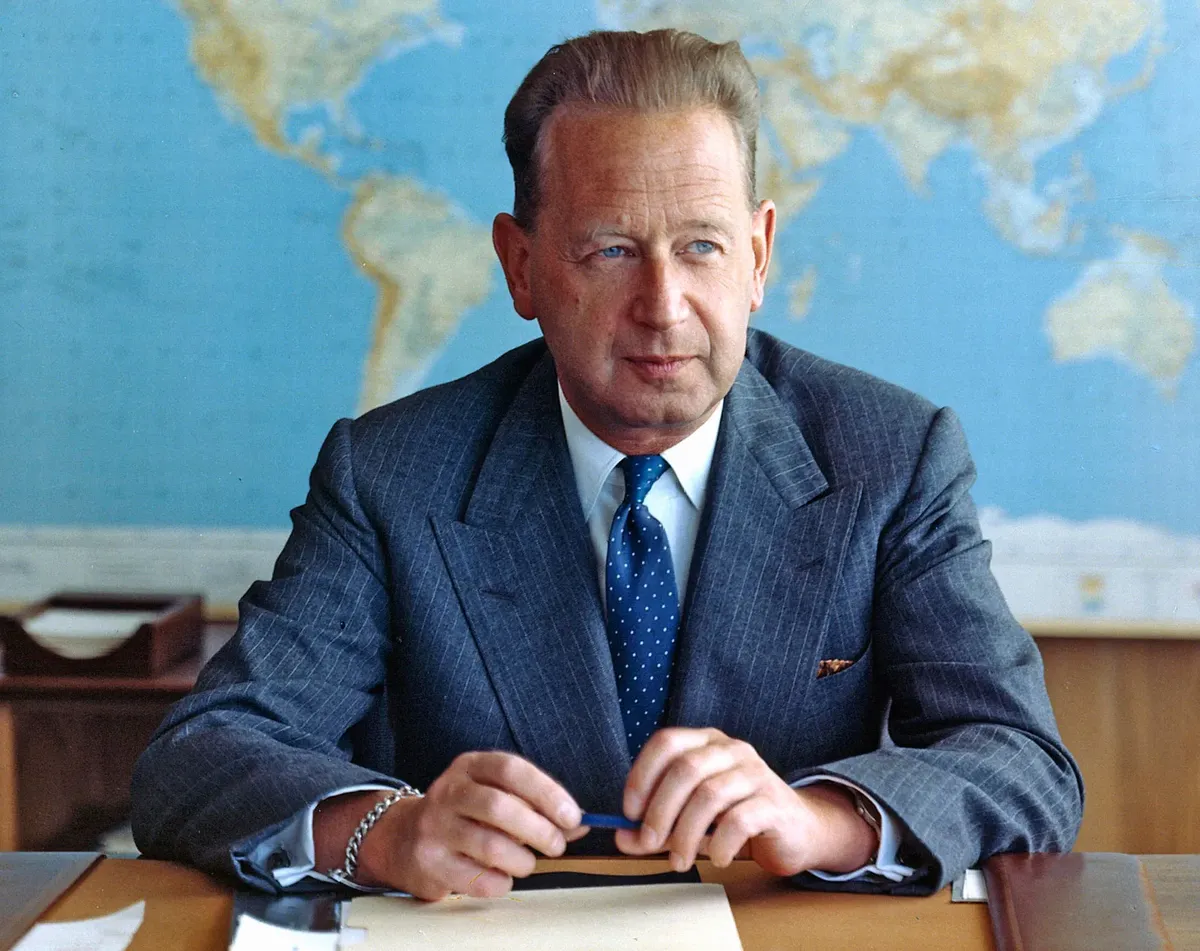
Dag Hammarskjöld
Dag Hammarskjöld (1905–1961) was a Swedish diplomat, economist, and the second Secretary-General of the United Nations, renowned for his commitment to peace, international cooperation, and humanitarian values. Born on July 29, 1905, in Jönköping, Sweden, Hammarskjöld was educated at Uppsala University, where he studied economics, law, and history. He later pursued a successful career in Swedish civil service, rising to key positions in the Swedish government, including Deputy Governor of the Swedish National Bank.
In 1953, Hammarskjöld was appointed Secretary-General of the United Nations, a role in which he would leave an indelible mark. During his tenure, he played a central role in addressing Cold War tensions, mediating conflicts, and advocating for global peace. His leadership was especially significant during crises such as the Suez Crisis (1956) and the Congo Crisis (1960), where he worked tirelessly to prevent escalation and promote diplomatic solutions. Hammarskjöld’s steadfast commitment to the principles of the UN and his personal integrity earned him widespread respect on the global stage.
Hammarskjöld's Christian faith was not conspicuous in his public life, but underwrote his work. His posthumously published book, Markings, is a collection of his personal reflections, poems, prayers, and philosophical writings, offering insight into his inner life with God and how it influenced his moral vision.
Tragically, Hammarskjöld died in a plane crash in 1961 while on a peace mission in Africa, under circumstances that remain mysterious to this day. His legacy as a champion of peace and diplomacy endures, and he is remembered as one of the 20th century’s most revered international leaders. Hammarskjöld was posthumously awarded the Nobel Peace Prize for his contributions to global peace.