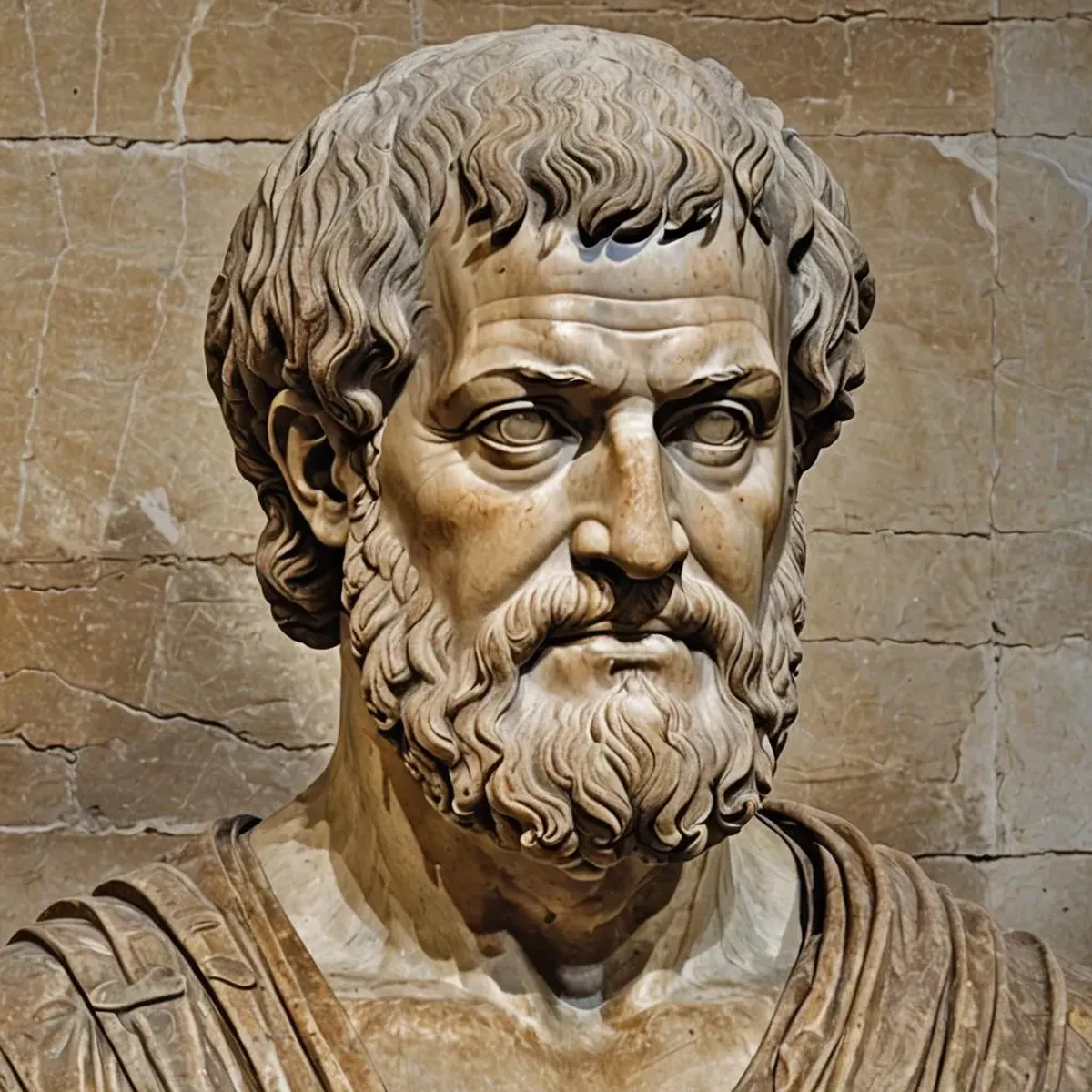
Aristotle
Aristotle (384–322 BCE) was an ancient Greek philosopher and polymath, widely regarded as one of the most influential thinkers in Western philosophy. A student of Plato and the teacher of Alexander the Great, Aristotle's contributions span a vast array of fields, including ethics, politics, metaphysics, logic, biology, and physics, laying the foundations for much of Western intellectual thought.
Born in Stagira, in northern Greece, Aristotle spent 20 years studying at Plato’s Academy in Athens before returning to Macedonia to tutor the young Alexander. His teaching significantly shaped the future king's views and policies. Later, Aristotle returned to Athens, where he founded his own school, the Lyceum, and conducted research in various scientific disciplines. His method of inquiry emphasized empirical observation and logical reasoning, distinguishing his approach from Plato’s more abstract philosophical methods.
Aristotle’s works on logic, particularly his development of syllogism and deductive reasoning, influenced the study of formal logic for centuries. His ethical philosophy, most notably articulated in the Nicomachean Ethics, is centered on the concept of virtue as a mean between extremes, advocating for a life of moderation to achieve eudaimonia, or flourishing. In politics, Aristotle wrote Politics, where he analyzed different forms of government, arguing that a constitutional government was the most stable and just.
Aristotle’s influence extends beyond philosophy into fields like biology, where his observations on animals and classification systems were ahead of his time. His comprehensive system of thought became the foundation for medieval scholasticism and significantly shaped later developments in science, theology, and politics.
Despite some inaccuracies in his scientific theories, Aristotle's intellectual legacy has endured for more than two millennia, cementing his place as one of the most important figures in the history of Western thought.