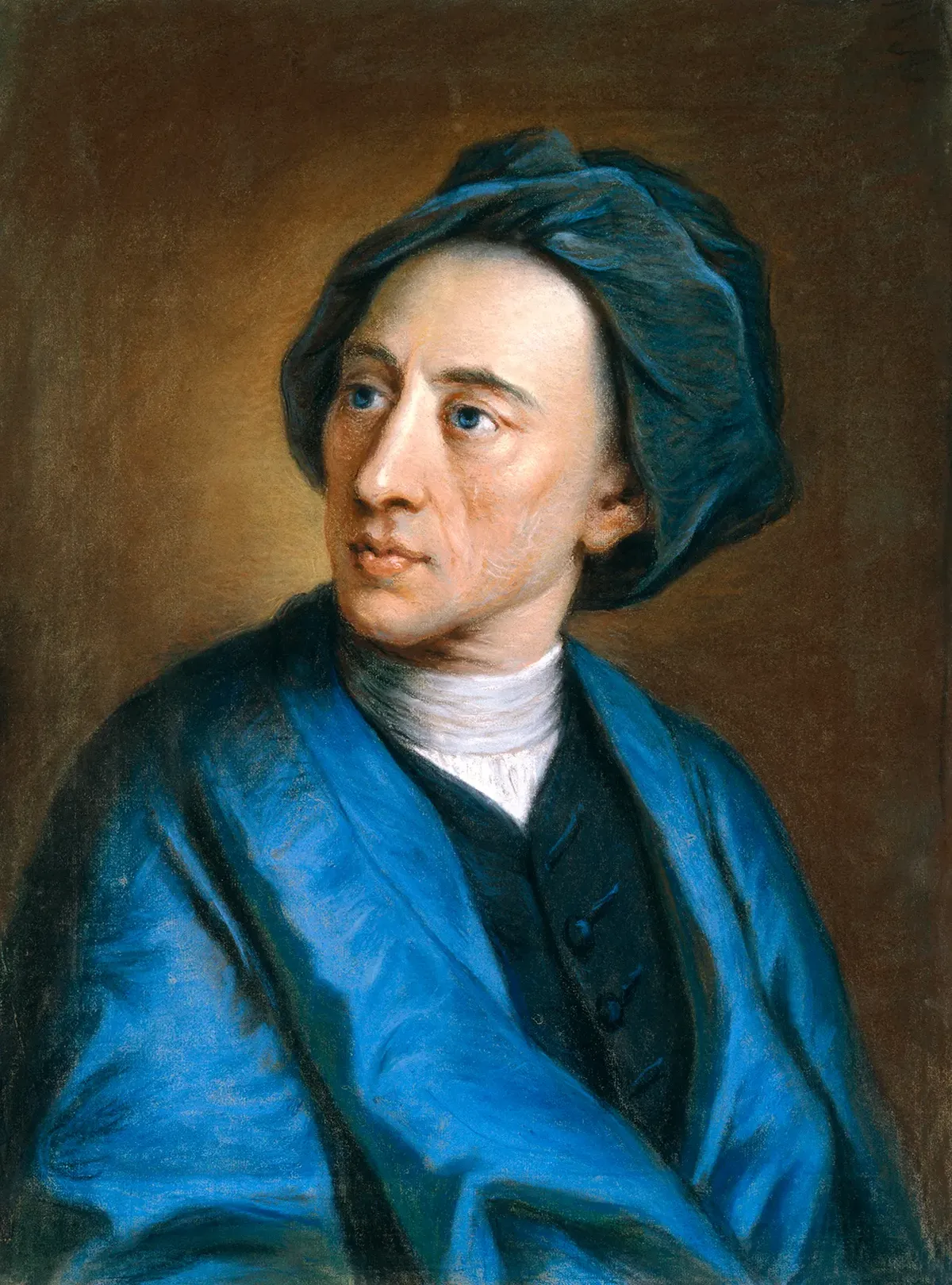
Alexander Pope
Alexander Pope (1688–1744) was an English poet, satirist, and critic, renowned as one of the most important figures of the Augustan Age of English literature. Born in London to a Roman Catholic family, Pope faced religious discrimination throughout his life due to the restrictive laws against Catholics in England. Despite these challenges, he became one of the most celebrated literary figures of his time.
Pope’s early education was informal and largely self-directed, as Catholics were barred from attending public schools or universities. His precocious talent for poetry emerged early, and by his mid-20s, he had established himself as a literary force with the publication of An Essay on Criticism (1711). This work, a blend of poetic insight and critical theory, offered advice to writers and critics, reflecting his admiration for classical forms and reasoned artistry.
His most famous works include The Rape of the Lock (1712–1714), a mock-epic that satirizes high society, and The Dunciad (1728–1743), a scathing critique of contemporary writers and cultural decline. Pope’s Essay on Man (1733–1734) is a philosophical poem exploring humanity’s place in the universe, emphasizing humility and the harmony of creation.
Pope was known for his mastery of the heroic couplet, a form he used to achieve precision, wit, and elegance. He also produced a highly influential translation of Homer’s Iliad and Odyssey, which earned him both financial success and critical acclaim.
A diminutive figure physically, due to lifelong health issues stemming from tuberculosis of the spine, Pope displayed remarkable resilience and wit. His sharp intellect, biting satire, and dedication to classical ideals made him both admired and controversial.
Pope spent much of his life in Twickenham, where he cultivated a celebrated garden. His legacy endures as one of the greatest poets in the English language.