Blog
May 14, 2024
Sacred Space: Lessons from Ethiopia’s Church Forests
Too Busy for God?
American work culture is all-pervasive. For many members of your congregation, it can be a real fight to get actual time off—and cell phones and the internet has made it possible to be "always on," something which is great for employers, but bad for souls. No wonder burnout is so ubiquitous.
Is it any surprise that so many Christians feel as if they are in a spiritual drought?
I propose that we take a roundabout route, with lessons from the global church, to think about the role that our own churches can play in our communities.
Ready for departure?
Google Earth makes world traveling easier than ever (Sorry, I can't afford to send you via plane.)
This image is an aerial view of part of the Gondar region of Ethiopia.
The landscape looks fairly barren and brown. If you look closely, though, there are a patchwork of dark green squiggles and blotches. The squiggles are field boundaries and watercourses. The blotches are forests. There aren't very many in this area, and they tend not to be very big. (I've marked them with yellow boxes in the image.) But even at this altitude, you'll notice a little light-colored dot in the middle.
Let's look more closely at just one of these.
The dot in the middle turns out to be a circular building nestled in among the trees. If you repeat this exercise with the others on the photo, you'd see the same sort of building in each of the forests I marked. If you went around the rest of the region looking for forests, you'd find one of these in almost every one. (Want to try it out? Go to Google Maps.)
What’s Going On?
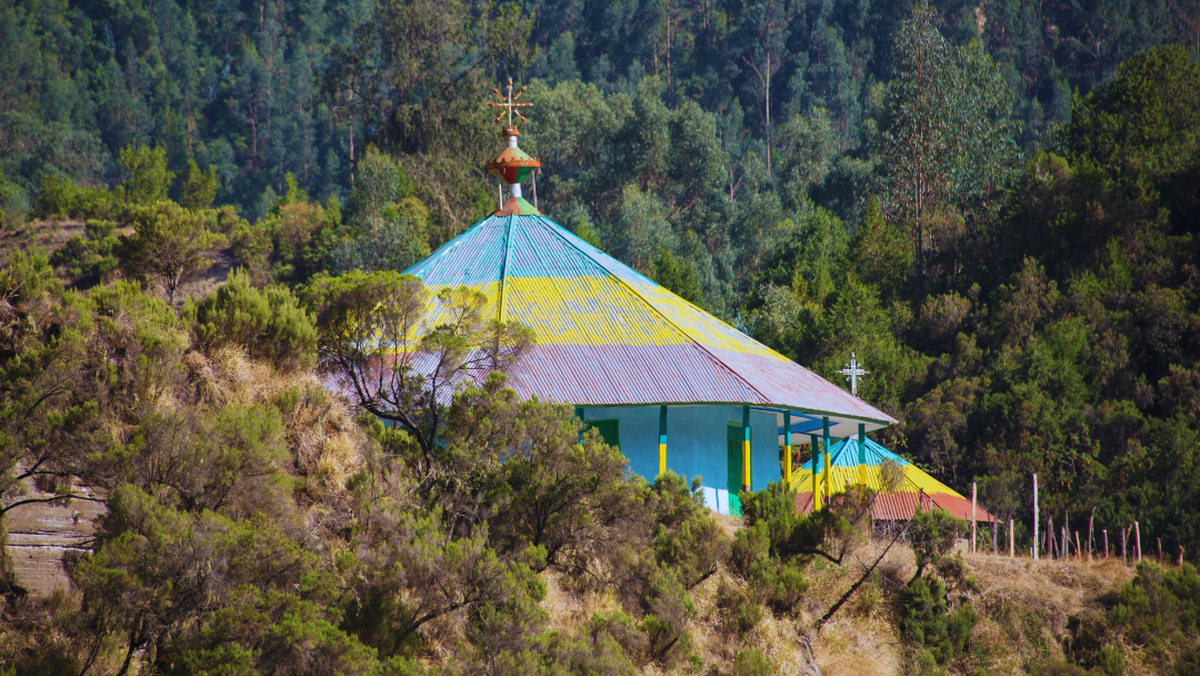
Those circular buildings are churches.
And it’s no coincidence that nearly all the forests you look at have them. Over the last century, Ethiopia’s forests have declined badly. 100 years ago, 35% of the country was covered in forests. Now, it is about 4.6% (though recent sattelite imaging suggests it may be as low as 0.2%) [1], [2]. Most of these forests have been lost to agriculture, especially farms and grazing—needed to feed the growing population. But the ecological consequences are dire. The loss of trees has led to erosion, the growth of invasive species, loss of pollinators, lack of fuel, dwindling groundwater, and a locally hotter and drier climate, not to mention the decline of native plant and animal species. These changes make agriculture yield less—and this drives more deforestation. Every year, the existing forests have dwindled.
But forests hang on near churches. This is because church forests are culturally and spiritually important in Ethiopia. They are symbols of heaven on earth and sacred “clothing” for the church itself [3]. There is no “nature worship” here, the trees can be cut, but like a garden, they are maintained, loved, and cared for. The forests are sacred insofar as they are set apart from the ordinary. They are like the Garden of Eden, a special place to be cared for – guarded and kept [4]. While the ground outside the forest bakes in the sun, there is a safe haven within the forest for native plants, insects, and animals in the cooler shade.
Today, however, there are moves by ecologists and the government to try to protect the forests, recognizing their cultural, ecological, and scientific value. Stone walls have been erected to keep cattle and plows out – indeed, in some places they are being used to allow the forest to slowly spread out. They are repositories of seeds that can be used to help forests recover elsewhere [4], [5].
Photo: This is an image of Bete Giyorgis (Church of St. George) in Lalibela, Ethiopia, one of a number of unique churches carved out of the rock.
Spiritual Lessons for the Church a World Away
In the West, Christianity has sometimes been blamed for de-sanctifying nature and encouraging its unbridled exploitation. This runs contrary to the actual text of Scripture, which teaches that humanity is to guard and steward creation—and probably speaks more to post-medieval western European philosophical/cultural trends (but that’s a rabbit trail we don’t need to follow today). The Ethiopian church forests at least show that creation care can be a vital part of church life and tradition.
They also provide a powerful image: dry brown fields given over to agriculture surrounding the lush life surrounding churches. We live in a world where the business of life continually erodes the sacred spaces among us. Our brown fields are the parts of our life given over to striving for success—sometimes even (like the Ethiopian farmers) just for survival. Our jobs demand we work Sundays. They demand that we are available on-call by cell phone. At the end of the week, the members of local congregations are often trudging in from the spiritual equivalent of those hot, dusty fields, shimmering with heat.
The term "burnout" is apt and it fits the image of a landscape scorched by the sun where nothing life-giving can take root and grow.
What do we offer them in our churches? If we are doing our job as churches, our churches are a spiritual resting place. Outside of the striving, there is acceptance, repentance, clearing of conscience, and rest. There is a transition from an ever-encroaching secular world that is sapping the spiritual “moisture” from our souls into the embrace of Christ himself—in the form of his body. The encircling shade of the ancient trees is life-giving and restoring. To mix metaphors, it provides the cool, living water we crave. No wonder Paul was so concerned about dealing with division and strife in his congregations. What kind of resting place do we provide if coming into our Lord’s presence to worship is disturbed by prideful power struggles or division?
And further, how do we both protect the scope of the sacred forest around our churches and expand it? What are the equivalents of the boundary-defining stone walls that protect our spaces of restoration and rest from the encroachment of both striving (even if necessary for life) and sin?
Applying These Lessons at Home
As I was contemplating this topic, a few vignettes came to mind, which illustrate ways in which, spiritually speaking, the striving of the brown land around the church forest can creep in and how the rest of the church forest can be protected and even reclaim land.
Lesson 1: Striving in church
I have attended many church services where I saw my fellow Christians in what almost appeared to be almost painful striving for connection with God during our singing. The deafening loudness of the music, the colored spotlights, the apparent spiritual transport of the song-leaders/performers, and the lyrics themselves all seemed to communicate that we needed to work very hard and create in ourselves very strong emotions in order to actually connect to our Lord.
Don’t get me wrong. This is not merely some hymn-loving curmudgeon’s complaint about praise music. The point here is not that praise music, even loud praise music, lights, or any of that is wrong (and hymns are not free of this problem).
The point is: does our whole package in our worship services suggest to people that God is far-off, uninterested in us, and in need of striving to connect with? Is trying to connect with God just like the striving of business and ordinary survival in the workplace? No. We are given grace freely by a loving and nearby God. Sure, sanctification involves work. But our church services should not be places of striving.
How about your church? Does your worship convey the idea that God is to be reached by striving or that His loving presence is given freely?
Lesson 2: Taking Sabbath rest together
I once visited an Antiochian Orthodox church where there was a communal meal after the service. I remember kids playing while adults chatted about theology or more mundane matters. It was just restful.
Coffee hours can be like this too. One of the things that attracted me to my current church was just the time spent by the congregation after church during the coffee hour talking together. It built relationships, community, and was a space of restoration.
Even more recently, members of this same church started telling leadership that they wanted to take Sabbath rest more seriously and asked to start having monthly meals together after the main service where the only thing on the agenda was spending time together. Our leadership team was all for it. It’s quickly become a popular tradition at the church.
Does your congregation find or create spaces in which to rest in each other’s presence?
Lesson 3: Mindfulness about Sabbath rest and recreation
I have a good friend whose spiritual maturity I greatly admire. Though he isn’t ordained, he works as hard for the church and parachurch organizations as do most pastors, especially on Sundays. Like many readers of this blog, he doesn’t get much rest on Sundays, so he takes his Sabbath rest on a different day of the week.
He is an avid bird-watcher, so a common Sabbath activity is taking a trip out into wild spaces to look at birds. Recently, he told me that he felt the Spirit telling him not to go birding. He took the lesson to be that his enthusiasm for looking for new birds, his striving in this hobby, was contributing to the burnout that he was battling. He instead spent time resting in God in meditation and prayer. His wisdom in listening to the Spirit and discerning how even a “restful” activity can erode the true need to find Sabbath rest in God impressed me — are we really finding our necessary Sabbath rest even on our Sabbaths (whether on Sunday or some other day)?
I’ll add that on the day that my friend chose to stay where he was, not go looking for birds, and spend time with God—a rare bird he had been looking for came right to him—as if it was a message from the Holy Spirit saying, “see, I care for you, your hobbies and all. Just rest in Me.”
Are you mindful of how you spend your own Sabbath time? Is there a sacred space to rest in God in your life?
Maintaining Spiritual Church Forests at Home
We’re pretty far afield from the sacred forests of Ethiopia by now. But I encourage you to prayerfully consider how your church may maintain sacred rest for your congregations—creating a spiritual church forest surrounding your church. Consider even bringing it up with your congregation—they may have insights about what rest might look like to them. And further, to consider your own spaces of sacred rest, how to guard and expand them.